Horses With Blue Eyes: Which Breeds and Colors Carry Them?
A horse gets blue eyes in one of two ways. Either it carries two copies of the cream gene (a cremello, perlino or smoky cream, whose eyes are always pale blue), or it carries a white spotting pattern, most often splashed white or frame overo, that leaves the eye without pigment. That is why blue eyes turn up in Paints, Quarter Horses, Miniatures, Gypsy Vanners and Icelandics, and only rarely in an Arabian or a Friesian.

A blue eye is not a different kind of eye. Brown eyes are brown because the iris is full of pigment; take the pigment away and what you see is blue, for the same reason the sky is. So the question “which horses have blue eyes?” is really “which genes switch off pigment in the iris?” Horsemen have called the result a wall eye, glass eye or china eye for centuries; we have a whole gallery of wall-eyed horses if you want to look into a few.
Route one: a double dose of cream

The cream gene is a dilution: it washes out coat color. One copy turns a chestnut into a palomino and a bay into a buckskin, and leaves the eyes brown. Two copies do far more:
- chestnut + two creams = cremello
- bay + two creams = perlino
- black + two creams = smoky cream
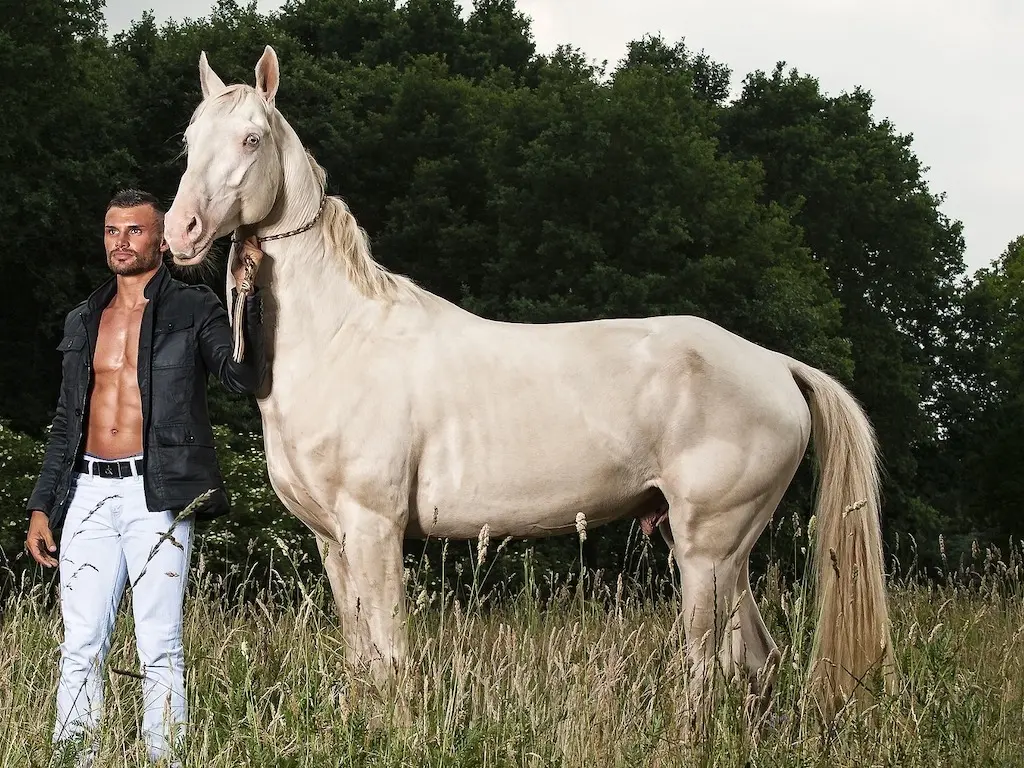
All three are cream to off-white, with pink skin and pale blue eyes, every time. The eyes are a soft, milky blue, noticeably lighter than the electric blue you get from a white pattern. These horses used to be called “albinos” and some registries refused them; they are not albino, and those rules have mostly gone.
Because cream is a simple gene, this is the one kind of blue-eyed horse you can plan. Two palominos have a one in four chance of a cremello foal; a cremello parent passes cream to every foal. Try the combinations in our foal color calculator.
Breeds: any breed that carries cream. That includes the Quarter Horse, Paint, Miniature, Welsh ponies, Connemara, Icelandic, Lusitano and Andalusian, and the Akhal-Teke, where pale cream coats are part of the breed’s fame. Cream is absent from the Arabian and is not found in the Friesian, so a “cremello Arabian” is either not purebred or not cremello.
Route two: white patterns
The other way to lose the pigment in an eye is to carry a gene for white markings. The cells that make pigment start near the spine of the embryo and migrate outwards; white patterns are what you see where they never arrived. If they don’t reach the iris, the eye is blue. That is why a pattern blue eye so often sits in a white face, and why a horse can have one blue eye and one brown, or an eye that is half and half.
Splashed white. A horse that looks as if it has been dipped in white paint feet first: white legs, white belly, and a broad white face. Splashed white is the blue-eye pattern above all others. The UC Davis genetics lab, which tests for it, describes these horses as having “often one or two blue eyes”. Eight different mutations are known. The commonest, called SW1, is thought to be several hundred years old and has been found in Quarter Horses, Paints, Appaloosas, Morgans, Trakehners, Miniatures, Shetlands, Welsh ponies, Gypsy Cobs, Knabstruppers and Icelandic horses.

Frame overo. Jagged white patches along the sides of the body, “framed” by color, usually with a lot of white on the face. A minimal frame horse can look almost solid, with nothing to show for it but a blaze and a blue eye. Frame is found mainly in Paints, Quarter Horses, Miniatures and Thoroughbreds, and it comes with a serious warning, below.
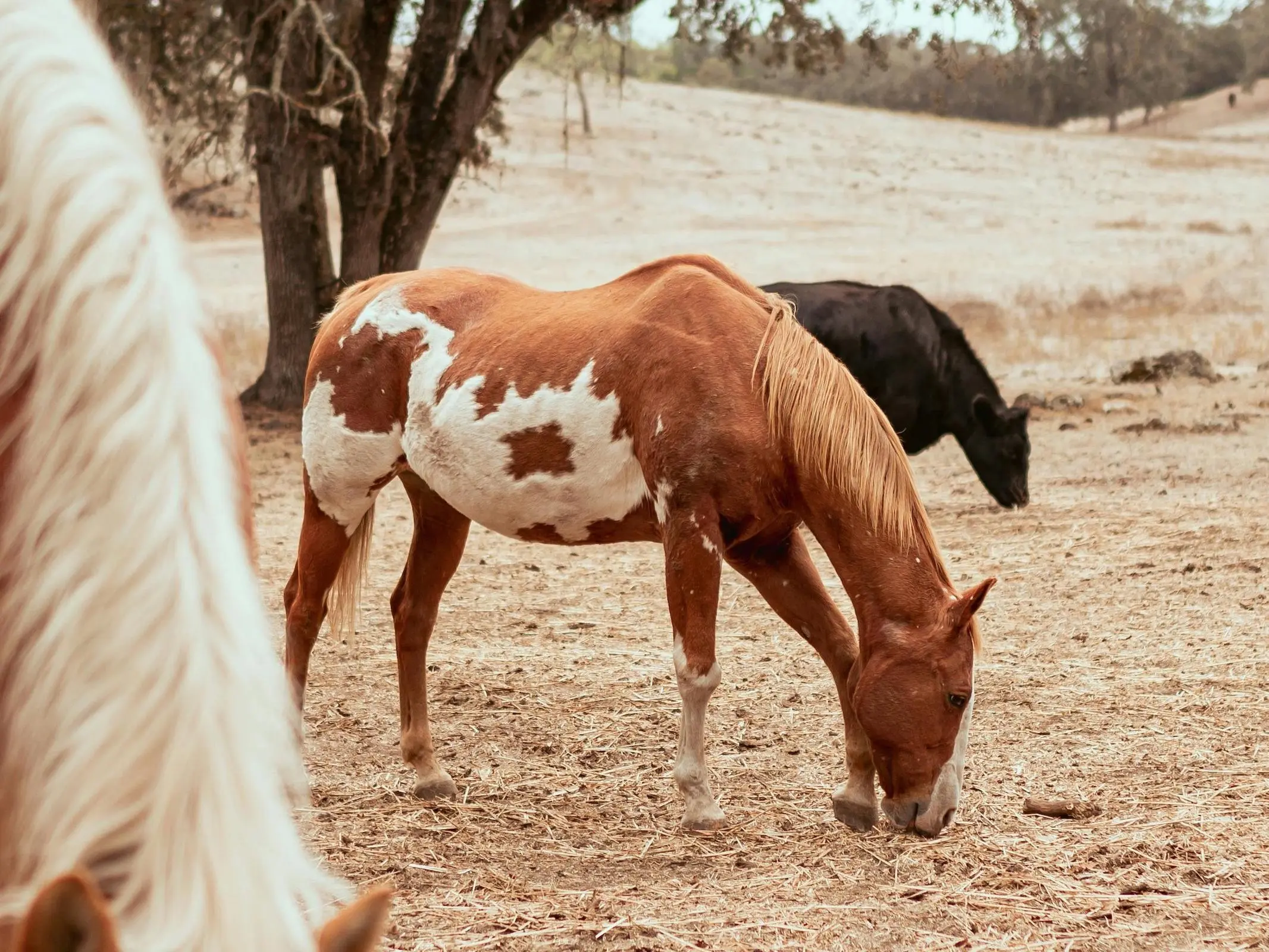
Tobiano. The big rounded patches of the classic pinto. Tobiano eyes are usually brown, though one or both may be blue or partly blue.
Solid horses. A horse with almost no white on it can still have a blue eye, when it carries a splash or frame gene that is barely showing. These are the ones that startle people.

By contrast, most dominant white horses, white from nose to tail, have ordinary brown eyes, and so do greys that have turned white with age. A white coat on its own tells you nothing about the eye.
The ones that aren’t quite blue
- Champagne. Champagne foals are born with blue-green eyes that darken to amber as they grow up. The American Cream Draft is the best-known champagne breed.
- Pearl with cream. A horse with one pearl gene and one cream gene looks like a double cream, with pale skin and blue or green eyes. This is an Iberian specialty.
- Tiger eye. A yellow, amber or bright orange iris found only in the Puerto Rican Paso Fino, caused by two variants of one gene that have no effect on the coat. Not blue, but worth a look.

Is a blue eye a problem?
On its own, no. A blue iris is an iris with less pigment, not a diseased one, and there is no good evidence that blue-eyed horses see any worse than brown-eyed ones. They are not blind, not night-blind and not wild, whatever the old dealers’ tales say.
The things that do matter travel with blue eyes rather than being caused by them:
- Pink skin. Blue eyes usually come with unpigmented skin around them, and pink skin burns. The eyelid is also the commonest site in horses for squamous cell carcinoma, a skin cancer that favors unpigmented skin, and sunlight is thought to play a part. A fly mask with UV protection is the standard precaution. Any sore, lump or raw patch on an eyelid that does not heal should be seen by your vet sooner rather than later.
- Deafness. Some splashed white horses are deaf, because the same missing pigment cells are needed in the inner ear. In one study of deaf Paint horses, all had extensive white on the head and legs and most had two blue eyes. Plenty of splashed whites hear perfectly well, and deaf horses can live and work normally, but it is worth knowing if your horse seems oddly unbothered by noise.
- Lethal white. A foal that inherits the frame gene from both parents is born all white and dies within days, because its gut never developed properly. This is why frame horses, including the ones that look solid, should be DNA tested before breeding, and why frame is never bred to frame. A single copy causes no such problem.
If you are buying a blue-eyed horse, buy it. If you are breeding one, test first.
Which breeds have blue eyes? The short list
| How | Eye color | Where you will see it |
|---|---|---|
| Double cream | Pale blue, always | Akhal-Teke, Quarter Horse, Lusitano, Welsh and Connemara ponies, Miniatures |
| Splashed white | Bright blue, often both eyes | Paint, Quarter Horse, Icelandic, Gypsy Vanner, Shetland, Morgan |
| Frame overo | Bright blue, one or both | Paint, Quarter Horse, Miniature, Thoroughbred |
| Tobiano | Usually brown, sometimes blue | Paint, Gypsy Vanner, Pintabian |
| Champagne | Blue-green at birth, then amber | American Cream Draft, Quarter Horse, Tennessee Walking Horse |
More to look at: our old galleries of blue-eyed horses and more blue-eyed horses, the full guide to horse colors, and the foal color calculator if you would like to design one.