How to Tell If Your Horse Is Cold: A Winter Blanketing Guide

A cold horse shivers, clamps its tail down, stands hunched and, over a few weeks, loses weight. A healthy horse with a dry winter coat, a windbreak and plenty of hay is usually far more comfortable than the person in three jumpers looking at it. Most blanketing mistakes come from judging the horse by how the human feels.
The Real Signs of a Cold Horse
There is no single test, so look at the whole animal.
- Shivering. The clearest sign. A brief shiver when a wet horse comes in is the body doing its job; shivering that carries on means the horse needs to be dried off, sheltered, fed or covered.
- Posture. Tail clamped, back hunched, head low, standing rump to the wind and reluctant to move off. A herd bunched tightly together behind the only hedge is telling you something about the shelter.
- A wet coat. A winter coat insulates by trapping air. Soaked through or plastered with mud, it lies flat and stops working. If snow sits on a horse’s back without melting, the coat is doing well; if the horse is wet to the skin, it is losing heat.
- Cold under the hand. Slide a hand under the blanket behind the withers, or onto the chest and flank of an unblanketed horse. It should feel dry and warm. Cool means not enough cover; damp and hot means too much. Ear tips and lower legs are poor guides on their own.
- Weight loss. The slow sign, and the one a thick coat or a blanket hides. Put your hands on the ribs every week through winter rather than trusting your eyes; our guide to body condition scoring shows how.
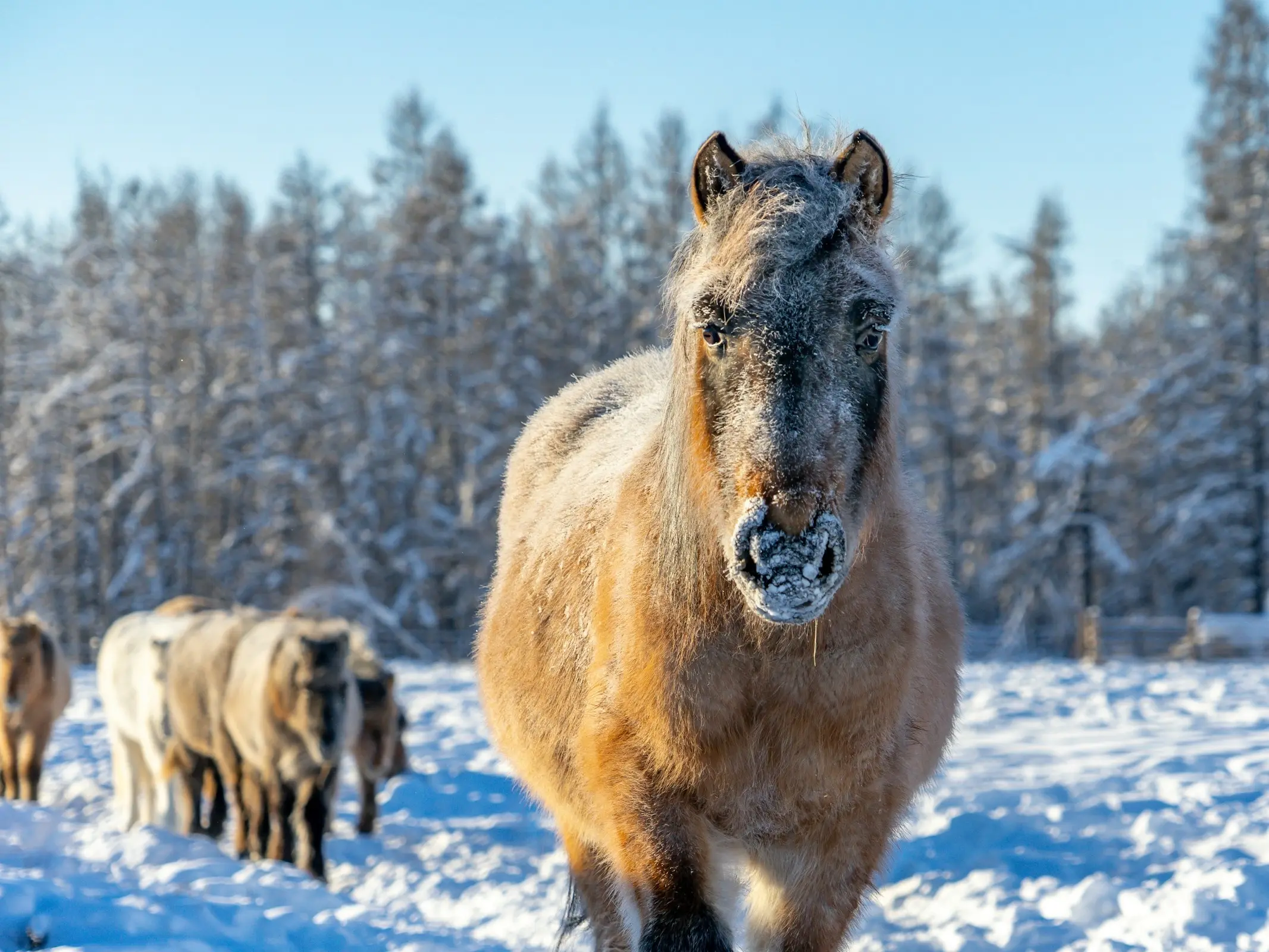
Frosted whiskers and ice balls in the feathers are not signs of a cold horse, provided the coat underneath is dry and nobody is shivering.
Shivering, a hunched stance and a wet coat are worth acting on. A horse you merely feel sorry for is not, yet.
The Thermoneutral Zone, in Plain Terms
Every horse has a band of temperatures in which it stays warm without spending extra energy. The bottom of that band is the lower critical temperature. Extension services in the northern United States put it at roughly 18°F (−8°C) for a horse in good condition with a full, dry winter coat, and about 40°F (5°C) for a horse in a summer coat. A wet or clipped horse sits near that higher figure or above it.
Below the line the horse is not in trouble; it simply burns more fuel. A common rule of thumb is about 1% more energy for every degree Fahrenheit below the critical temperature. Horses also acclimatise, a process that takes around three weeks, which is why a sudden cold snap in October is harder on them than steady cold in January.

Hay Is the Heater
Fibre is fermented in the hindgut, and that fermentation gives off heat. So the first answer to cold weather is more forage, not more grain. Utah State University’s worked example has an 1,100 lb (500 kg) horse going from about 19 lb of hay a day at 20°F to about 24 lb at 0°F. Our feeding calculator will give you a baseline to work up from, and the weight calculator will tell you what you are feeding in the first place.
Hay needs water to go with it. Horses drink less when the water is icy, and dry forage with too little water is a recipe for impaction colic. Water kept at around 45–60°F (7–16°C) gets drunk; a bucket with a crust of ice mostly does not. Break ice at least twice a day if you have no heater.
Shelter, Coat and Clipping
A horse can cope with a great deal of cold if it is dry and out of the wind. Rain, sleet and wind strip heat much faster than still, dry cold or snow. A run-in shed or a thick hedge is worth more than a blanket to most horses, and Rutgers puts the saving at up to 20% of body heat compared with standing fully exposed.
The winter coat grows in response to shortening days, not to temperature, so it starts in late summer whatever the weather. Breed matters a good deal. A Shetland, an Icelandic or a Yakut, which lives further north than any other breed, grows a coat a Thoroughbred or an Arabian can only dream of.
Clipping changes everything. A clipped horse has had its insulation removed so that it can work without sweating, and it needs that insulation replaced with a blanket whenever it is not working. Clip only as much as the workload requires.
Age and Condition
Body fat is insulation, so a thin horse feels the cold sooner than a round one. Old horses often carry less fat and muscle, may struggle to chew enough hay, and can be pushed off the shelter and the feed by younger companions. Foals and youngsters have a higher critical temperature than adults. Sick horses, and horses newly arrived from a warmer climate with the wrong coat for the season, also need help. If an older horse is dropping weight in winter despite good feed, that is a question for your vet, not just for the blanket rack.
A Sensible Temperature Guide
This is guidance, not a rulebook. It assumes a dry day with little wind; rain and wind move every horse down a row or two.
| Temperature | Full winter coat, good weight, has shelter | Clipped, thin, elderly or not acclimatised |
|---|---|---|
| Above 50°F (10°C) | Nothing | Usually nothing; a light sheet for a fully clipped horse |
| 40–50°F (5–10°C) | Nothing | Sheet or light blanket |
| 30–40°F (−1 to 5°C) | Nothing if dry; a waterproof sheet in cold rain with no shelter | Light to medium blanket |
| 18–30°F (−8 to −1°C) | Usually nothing; extra hay | Medium blanket |
| Below 18°F (−8°C) | Extra hay; a blanket if there is no shelter or the horse is wet | Heavy blanket, neck cover if clipped |
| Below 0°F (−18°C) | Blanket if there is no shelter; plenty of hay either way | Heavy blanket, shelter and close watching |
Then check the horse, not the chart. Shivering means add warmth. Sweat under the blanket means take some away.
When Not to Blanket
- On a wet horse. Dry it first, with a wool or fleece cooler if needed. A blanket over a wet coat traps the damp against the skin.
- On a warm afternoon. A horse sweating under a heavy blanket at midday will be damp and chilled by midnight. Over-blanketing is a more common fault than under-blanketing.
- With a blanket that leaks or does not fit. A sodden blanket flattens the coat and makes things worse than no blanket at all. A poor fit rubs shoulders and withers raw.
- Because you are cold. A horse’s comfort zone sits well below ours.
- On a fat, hairy, healthy pony with shelter. Burning a little extra fuel in winter is no bad thing for an animal that is too well covered already.
Once you start blanketing you have largely committed for the season, because a blanket flattens the coat and reduces the insulation the horse grew for itself. Take it off regularly, daily if you can and at least weekly, to groom and to check for rubs, skin trouble and the weight change you would otherwise miss.
In a study published in 2016, Norwegian researchers taught 23 horses to touch symbols meaning “blanket on”, “blanket off” or “no change”. The horses asked to stay uncovered in fine weather and asked for blankets when it was wet, windy and cold. They have opinions on the matter, and those opinions track the weather rather than the calendar.
More Winter Reading
Our seasonal care guide covers the rest of the year, care tips and stabling cover the basics, and if you would rather just look at horses enjoying the weather, here are some Clydesdales having a snowball fight.
Sources: Utah State University Extension and Rutgers Cooperative Extension winter care and blanketing fact sheets; Mejdell et al., “Horses can learn to use symbols to communicate their preferences”, Applied Animal Behaviour Science, 2016. We are not veterinarians: if your horse is shivering and will not warm up, is losing weight or seems unwell, call your vet.