Is My Horse Overweight? Body Condition Scoring Made Simple
Run your hand along your horse's ribs. If you can feel them easily under a thin, springy layer but cannot see them, the horse is about right. If you have to press to find them, it is overweight, and if you cannot find them at all, it is obese. That is the heart of body condition scoring; the rest is doing the same thing in five more places and writing down a number.
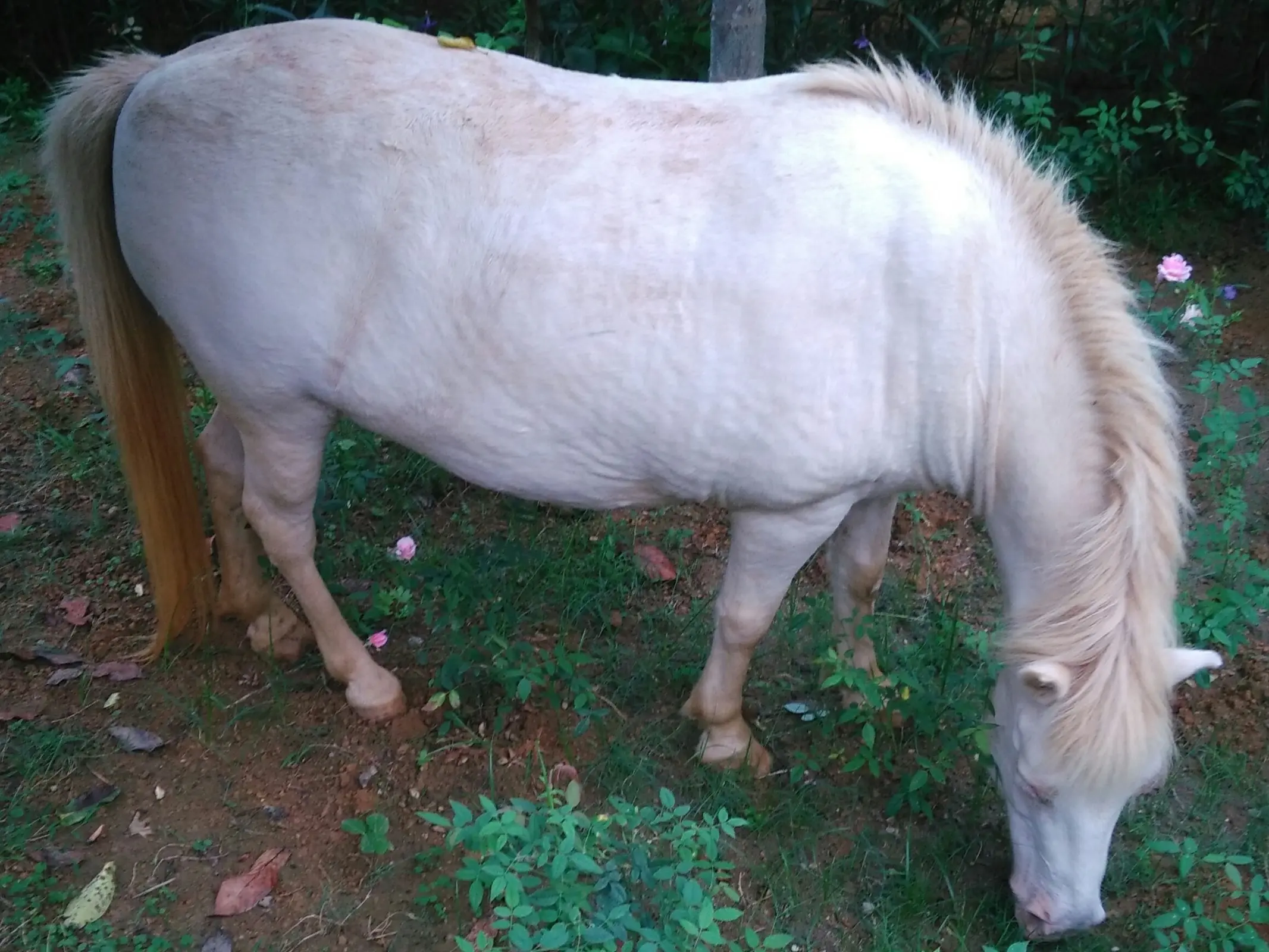
It matters because eyes adjust. In a Virginia study of 300 horses, about half were overconditioned or obese, and studies in several countries have found that owners tend to score their own horses leaner than a trained assessor does. When most of the horses on a yard are a bit fat, a bit fat looks normal.
The Henneke scale
The system most vets use was developed by Don Henneke at Texas A&M University and published in 1983. It scores fat cover from 1 to 9 by looking at and, more importantly, feeling six parts of the body. It needs no equipment, works on any breed, and is the scale welfare officers use when they have to describe a horse’s condition objectively.
| Score | Name | What you find |
|---|---|---|
| 1 | Poor | Emaciated. Spine, ribs, hips and tailhead stand out sharply; no fat anywhere |
| 2 | Very thin | Bones still prominent, with only a slight covering |
| 3 | Thin | Ribs easily seen; a little fat over the spine; hip bones rounded but obvious |
| 4 | Moderately thin | Faint outline of the ribs visible; a slight ridge along the back |
| 5 | Moderate | Ribs felt easily but not seen; back level; shoulders and neck blend smoothly into the body |
| 6 | Moderately fleshy | Ribs felt with light pressure; fat around the tailhead feels soft; beginning of a crease down the back |
| 7 | Fleshy | Ribs felt only with firm pressure, fat between them; crease down the back; fat along the neck and withers |
| 8 | Fat | Ribs hard to find; obvious crease; thick neck; soft fat around the tailhead and inner thighs |
| 9 | Extremely fat | Deep gutter down the back; bulging, patchy fat over the ribs, tailhead, withers and neck |
For most horses the healthy range is 4 to 6, with 5 the usual target. Where exactly depends on the type and the job: a fit Thoroughbred in work may sit at a lean 4 to 5, a native pony going into winter at 6.
Where to look and feel
Score each of the six areas from 1 to 9, then average them. Use the flat of your hand and firm pressure; a winter coat hides a great deal, in both directions.
- Neck. Feel along the crest, the top line under the mane. It should be firm and narrow, not thick or wobbly.
- Withers. In a thin horse they stand up sharp; in a fat one they are buried.
- Behind the shoulder. A fat pad develops just behind the elbow and shoulder blade, where the girth lies.
- Ribs. The most useful single check. Easily felt, not seen, is a 5.
- Loin and back. A ridge means too thin; flat is right; a gutter you could pour water down means too fat.
- Tailhead. Fat here feels soft and spongy, and builds into pads either side of the tail.
Two cautions. A big belly is not fat: it may be a hay belly, a pregnancy or worms, and thin horses often have one. And different types carry fat differently, so a cob and a racehorse with the same score will not look the same. Feel, do not just look.
In Britain you may meet a 0 to 5 scale instead, which works the same way with fewer steps. We have a World Horse Welfare video showing how to fat score with it.
The cresty neck
Fat along the top of the neck deserves its own score, because it is closely linked to insulin problems, sometimes in horses that do not look fat elsewhere. The cresty neck score, published by Carter and colleagues in 2009, runs from 0 to 5.
| Score | The crest |
|---|---|
| 0 | No crest to see or feel |
| 1 | Nothing to see, but a slight filling can be felt |
| 2 | A visible crest, with fat spread evenly from poll to withers; it can be cupped in the hand and bent from side to side |
| 3 | Enlarged and thickened, heaped in the middle of the neck; starting to lose its side-to-side flexibility |
| 4 | Grossly enlarged, hard to bend, may have creases across it |
| 5 | So large it has permanently fallen to one side |
A score of 3 or above is a warning sign, whatever the rest of the horse looks like. A crest that suddenly feels harder than usual is worth a call to the vet.
Why it matters
- Laminitis. Obesity, and above all fat on the neck and tailhead, goes with insulin dysregulation, the hormonal problem behind most cases of pasture laminitis. Laminitis is painful, can be crippling and often comes back. Here is how to recognise the early signs.
- Equine metabolic syndrome (EMS). The name for that combination of regional fat, insulin dysregulation and laminitis risk. Ponies, cobs, native breeds, Morgans, Arabians and other “good doers” are particularly prone. It is diagnosed by blood test, so ask your vet if your horse scores 7 or more or has a cresty neck.
- Wear and tear. Extra weight loads joints and feet, makes work harder and slows cooling in hot weather. It also uses up the horse’s own weight-carrying capacity before the rider gets on.
- The thin end. A score of 3 or less needs explaining too. Teeth, worms, pain, illness, bullying at the hay feeder or simply not enough food are the usual suspects, and the vet is the place to start.
Pair the score with a weight
A condition score tells you how fat the horse is; a weight tells you how much horse there is. You need both. Weight alone cannot tell a fit 500 kg from a flabby one, and a score alone will not show a slow drift.
Measure the heart girth and body length and put them into our weight calculator, or use a weigh tape. Neither is exact, but both are consistent, and it is the trend you are after. Record weight, condition score and cresty neck score every two weeks, in the same place and at the same time of day.
If the answer is yes
Slimming a horse is slow, and the safe way to do it is with your vet. The outline is always much the same:
- Weigh the forage. Guessing is how the horse got here. The feeding calculator and nutrition calculator will give you starting figures.
- Do not starve it. Veterinary guidance for weight loss is typically around 1.25 to 1.5 percent of body weight a day in forage, measured as dry matter, and not less without a vet supervising. Cutting feed too hard can trigger hyperlipaemia, a dangerous disorder of fat metabolism, particularly in ponies, miniature horses and donkeys.
- Cut the calories, not the fibre. Drop grain and sweet treats first (see what horses can eat), choose a lower-calorie hay, and ask your vet about soaking it. Keep a vitamin and mineral balancer in the diet.
- Limit grass. A grazing muzzle, strip grazing or a track system all reduce intake while keeping the horse out and moving.
- Add exercise, if the horse is sound. If it has had laminitis, get the vet’s agreement first.
- Aim for slow, steady loss and re-score every fortnight. Expect it to take months.
There are more ideas in our tips for managing your horse’s weight and why weight matters.
We are not veterinarians. Sudden weight loss, a hard or swollen crest, or any sign of sore feet needs a vet, not a diet sheet.