How to Read Horse Body Language: Ears, Tail and Eyes Explained
Start with the ears. Pricked forward means the horse's attention is in front of it; turned back means it is behind; pinned flat against the neck means stop what you are doing. Then check that reading against the eyes, the muzzle, the tail and the feet, because one signal on its own is easy to misread. The whole horse is the sentence.
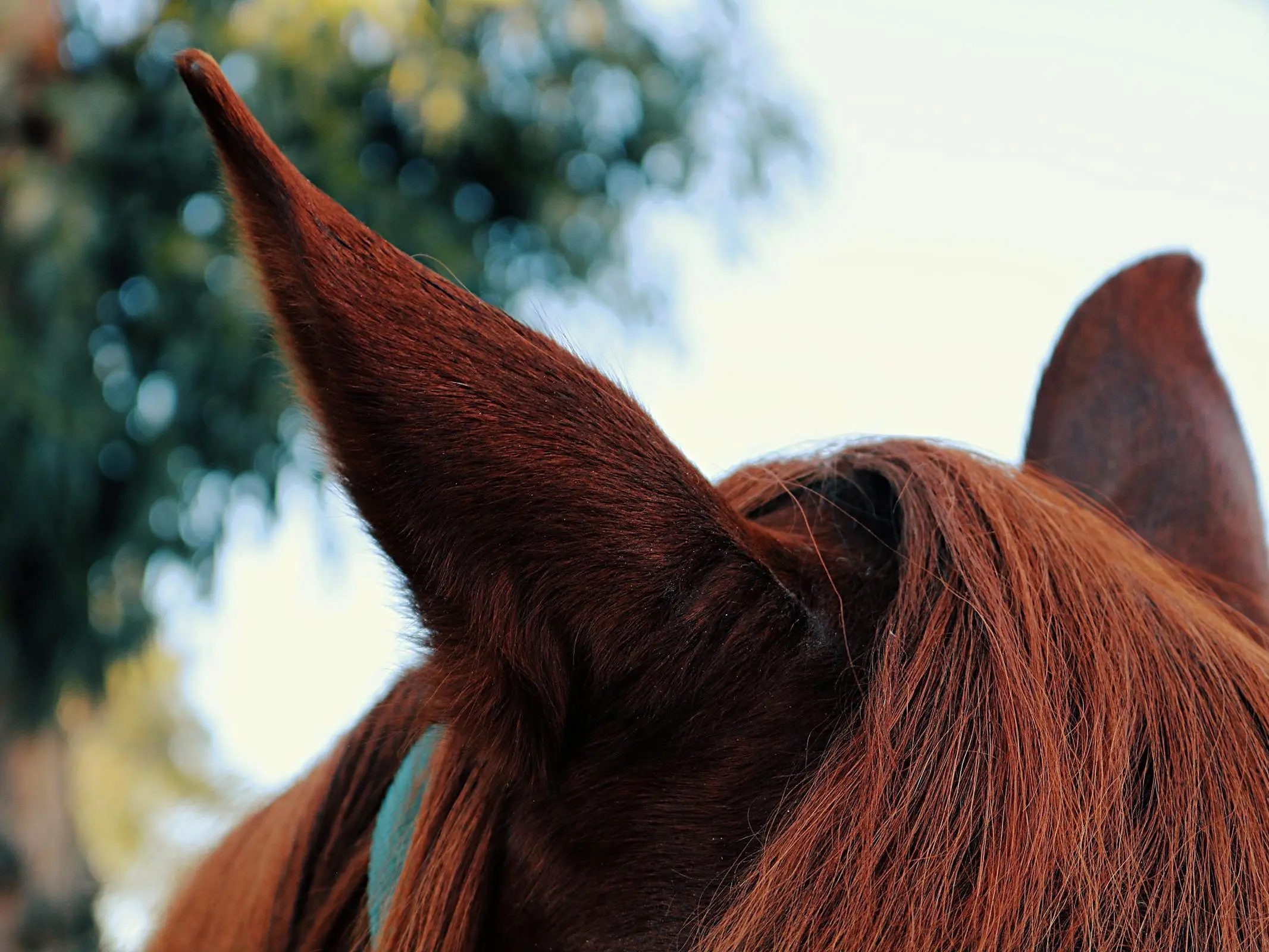
Horses are prey animals that live in groups, so they are built to signal quietly and to read each other at a distance. They are doing it all day. The more of it you can read, the safer and more pleasant you are to be around.
Ears
Each ear moves on its own and points where the horse’s attention is.
| Ears | Usually means |
|---|---|
| Both pricked forward | Interested in something ahead; if the head is high and the body stiff, alarmed by it |
| One forward, one back | Attention split; common in a ridden horse listening to its rider |
| Turned softly out to the sides, relaxed | Dozing or at ease |
| Flicking back and forth quickly | Uncertain, anxious, trying to locate something |
| Turned back but loose | Listening behind, or concentrating |
| Pinned flat back against the neck | Angry or threatening. Take it seriously |
| Stiffly held back or drooping, with a tense face | Possible pain (see below) |
The difference between “back” and “pinned” is the one to learn first. Ears turned back with a soft eye are just listening. Ears flattened so hard they almost disappear into the mane, with a tight mouth and wrinkled nostrils, are a threat.
Ears are also how horses read each other. In a 2014 study, horses choosing between two feed buckets followed the direction of another horse’s gaze in a photograph, but not when its ears or its eyes were covered. We have a whole gallery of horse ears, if you would like to practise.
Eyes
- Soft, with drooping lids and slow blinks: relaxed.
- Wide, with the white showing: frightened or very excited. (Some horses show white all the time, Appaloosas especially, so know what is normal for yours.)
- Tight, with the lid partly closed and wrinkles or tension above the eye: worry or pain.
- Fixed and staring, with the horse withdrawn: often pain or illness.
A horse’s eyes sit on the sides of its head, which gives it a very wide view with a blind spot directly behind and another right in front of its nose. That is why you approach at the shoulder and speak first.
Nostrils, lips and chin
- Loose lower lip, soft round nostrils: relaxed. A dozing horse’s bottom lip may hang and wobble.
- Flared nostrils: hard work, excitement or fear.
- Tight lips, a clenched jaw and a chin that looks flattened or bunched: tension or pain.
- Nostrils pinched and wrinkled at the back, lips drawn tight: irritation, usually with the ears pinned.
- Top lip curled up, nose in the air: the flehmen response. The horse is drawing a smell into a special organ in its nose. It is not laughing at you.
- Yawning is not well understood; it may be relaxation after tension, and frequent yawning can go with discomfort. It is still funny.
Head and neck
A lowered head with a level neck belongs to a calm horse; a high head on a stiff neck belongs to an alert or frightened one. A neck stretched out low with the ears flat and the nose pushed forward, called snaking, is a horse driving another horse (or you) away.
Tail
| Tail | Usually means |
|---|---|
| Hanging loose, swinging with the stride | Relaxed |
| Lifted or “flagged” | Excited, playful, alert |
| Clamped down tight | Frightened, cold, or uncomfortable |
| Swishing lazily | Flies |
| Lashing or wringing | Irritated or in pain; under saddle, often an objection to the rider’s leg or hand |
Legs and stance
- One hind leg resting on the toe, hip dropped: relaxing. Normal.
- Pawing: impatience or frustration; with other signs, colic.
- Stamping: flies, or irritation.
- A front foot “pointed” out in front, or constant shifting of weight: sore feet or legs. Call the vet.
- A hind leg lifted with the ears back, or the hindquarters swung toward you: a warning that a kick is available. Move out of range and to the shoulder.
Putting it together
Relaxed

Image from Ies
Head level with the withers or lower. Ears out to the side or drifting. Eyes half closed, lower lip loose. A hind leg resting, tail still. Breathing slow. This is the horse you want to groom, catch and tack up.
Alert

Image from Armin Ulrich
Head up, both ears and both eyes fixed on the same thing, nostrils open, body still. The tail may lift. An alert horse is gathering information and has not yet decided what to do about it. Give it a moment to look.
Anxious or frightened
Head high, the whites of the eyes showing, ears flicking, nostrils flared, perhaps a loud snort. The muzzle is tight, the muscles are hard, the tail is clamped or straight up, and the feet will not stay still. The horse may pass droppings repeatedly. Fear in a horse turns into movement very quickly, so stay calm, stay out of its path and do not wrap the rope round your hand.
In pain
Pain is the hardest state to read, because an animal that evolved being hunted does not advertise weakness. Researchers have therefore looked closely at the face. The Horse Grimace Scale, published in 2014 by Emanuela Dalla Costa and colleagues from work with horses recovering from routine castration, scores six signs from 0 to 2:
- ears held stiffly backwards
- tightening around the eye, the lid partly closed
- tension above the eye, so the bony ridge stands out
- prominent, strained chewing muscles
- a strained mouth with a pronounced chin
- strained nostrils and a flattened profile
A Danish group led by Karina Gleerup described a very similar equine pain face the following year: low or asymmetrical ears, an angled eye with a withdrawn, tense stare, nostrils dilated sideways, and tension in the lips, chin and jaw muscles.
Away from the face, watch for a horse that stands at the back of the stable with its head low, will not move, shifts its weight, looks round at its flanks, paws, lies down and gets up repeatedly, grinds its teeth or goes off its feed. Under saddle, the Ridden Horse Pain Ethogram developed by Sue Dyson lists 24 behaviours, from ears back and tail swishing to an open mouth and crooked movement; a horse showing eight or more is likely to have a musculoskeletal problem.
Any of these is a reason to call the vet. A horse that is rolling, sweating and looking at its belly has colic until proved otherwise, and that is an emergency.
Angry

Image from Dani_vr
Ears flat. Nostrils pinched and wrinkled, mouth tight or open with teeth showing. Neck snaking, tail lashing. The hindquarters turn toward the target, or a hind foot lifts. Horses almost always warn before they bite or kick, and the warnings escalate roughly in that order. Heed them, give the horse room, and then find out what it was objecting to. Sudden bad temper in a normally pleasant horse is very often pain.
They are reading you, too
It works both ways. In a 2016 experiment, horses shown photographs of angry human faces looked at them with the left eye, as they do with things they consider threatening, and their heart rates rose faster than when they were shown happy faces. Researchers who catalogued the horse’s facial muscles for a coding system called EquiFACS counted 17 distinct facial movements, more than have been found in chimpanzees.
So breathe out, drop your shoulders and approach at an angle. The horse noticed your mood before you noticed its ears.
For more faces, see our gallery of horse facial expressions; and if you are about to bring a horse home, the first horse checklist covers the rest.