How Long Do Horses Live? Lifespan by Breed

On average a domestic horse lives 25 to 30 years. Size matters more than anything on the pedigree: ponies and miniatures regularly reach their thirties and sometimes their forties, while the giant draught breeds tend to have shorter lives. The record, set two centuries ago and never beaten, is 62.
The Honest Answer About Breeds
The 25 to 30 year average is the figure given by the Merck Veterinary Manual, which adds that lifespan depends on health, care and size, and that miniature horses can live 40 years or more.
Beyond that, be suspicious of any table that gives a precise lifespan for every breed. Nobody has followed thousands of Morgans or Percherons from birth to death and published the result. What exists is a broad pattern that vets and owners agree on, and one useful piece of hospital data: when researchers reviewed 467 horses aged 20 and over treated at an American university hospital in the 1990s, ponies were over-represented among the animals aged 30 and older.
So here is the pattern, with examples from our breed pages. Heights are the ones given on each breed’s page; life expectancies are typical ranges, not promises.
| Type | Examples (height) | What to expect |
|---|---|---|
| Miniatures | Falabella (6.1 – 7 hands), American Miniature | Often 30 and beyond. Merck notes they can reach 40 or more. |
| Ponies | Shetland (10.2 hands), Welsh Mountain Pony (12 hands), Exmoor (11.2 – 12.3 hands) | Commonly into the 30s. The group most likely to make very old bones. |
| Small, hardy horses | Icelandic (13 – 14 hands), Norwegian Fjord (13 – 14.1 hands), Haflinger (13 – 15 hands) | Late 20s to 30s is usual with good care. |
| Light riding horses | Arabian (14.1 – 15.1 hands), Morgan (14.1-15.2 hands), American Quarter, Thoroughbred | The 25 to 30 average was more or less written about these. |
| Heavy draught horses | Shire (17 hands), Clydesdale (17-18 hands), Belgian Draft (15.3 – 17.3 hands), Suffolk Punch (16.1 – 17.1 hands) | Usually quoted a few years shorter, with the early to mid 20s a good age for a very big horse. |
Being a draught breed is not the whole story, though. Smaller working breeds can be very durable: our page on the Black Forest horse (14.2 – 15.3 hands) describes a small, tough draught breed known for its long life span.
 Falabella
A miniature at 6.1 – 7 hands. The small ones tend to last.
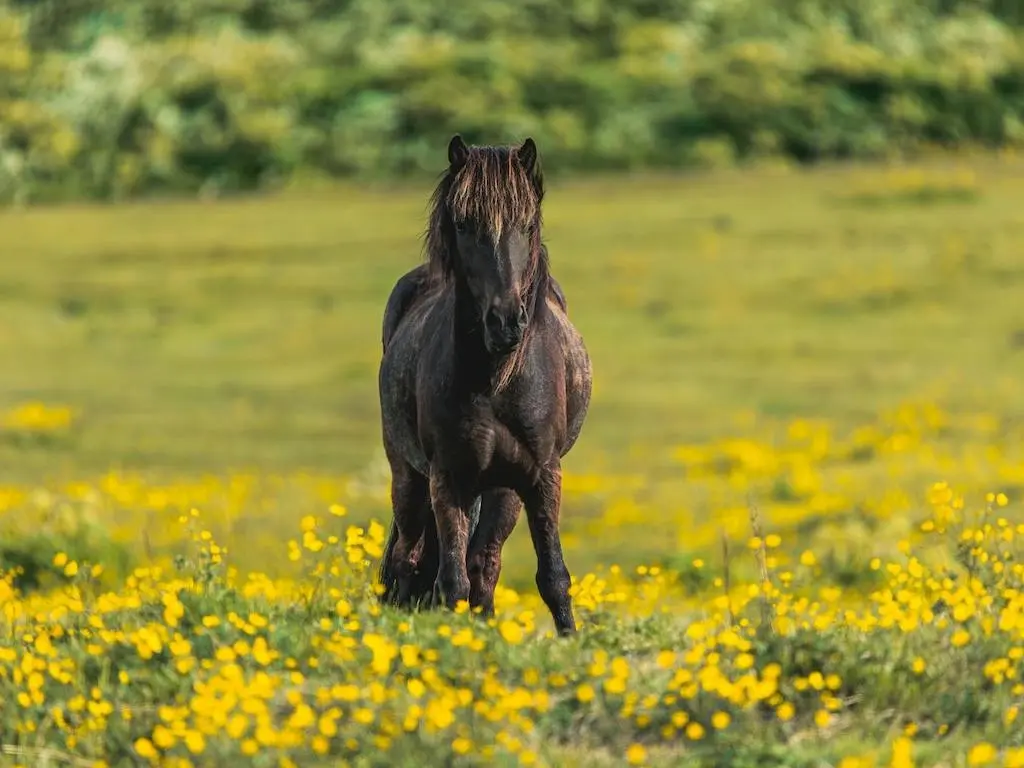 Icelandic
Small, tough and typical of the hardy northern types.
 Shire
At 17 hands, one of the giants. Size comes at a cost.
Why Ponies Outlast the Big Horses
No one has a complete explanation, but the same thing is seen in dogs: within a species, the small ones tend to live longer. A ton of horse puts more load on joints, feet and heart over a lifetime than 200 kilos of pony does. Ponies also come from mountain and moorland stock that was shaped by hard winters and poor grazing, with nobody selecting for speed or size.
The pony’s advantage comes with a catch. The same thrifty metabolism that kept its ancestors alive on a Shetland hillside makes it very easy to overfeed on modern pasture, and an overweight pony is a prime candidate for laminitis.
What Actually Decides How Long a Horse Lives
Breed sets the range. These decide where in the range your horse ends up.
- Teeth. A horse’s teeth erupt slowly throughout its life and are worn down by chewing. In a very old horse they eventually wear out, and a horse that can’t chew can’t use its food. Regular dental checks and, later, soaked feeds can add years.
- Weight. Fat horses get laminitis and strain their joints. Thin old horses are usually telling you something about their teeth or their health. The Weight Calculator and Feed Calculator take the guesswork out of both.
- The gut. In the hospital study above, colic was the most common reason old horses were brought in, followed by lameness. Steady routines, plenty of forage and constant water are the best protection there is.
- Hormones. Pituitary dysfunction (PPID, or equine Cushing’s disease) was one of the most common diagnoses in those older horses, especially the over-30s, and it was strongly linked with laminitis. It is treatable, so an old horse with a long curly coat that doesn’t shed needs a vet, not just a clip.
- Work and wear. A horse worked sensibly stays sounder than one worked hard too young or left idle and overweight.
- Care in general. Vaccination, parasite control, good feet and somebody who notices small changes early. Our horse care pages cover the routine.
What Is That in Human Years?
The usual conversion counts a horse’s first year as 6.5 human years, the second as 3.5 and every year after that as 2.5. On that scale:
- a 20-year-old horse is about 55
- a 25-year-old is 67 and a half
- a 30-year-old is 80
- a 40-year-old pony is 105, and entitled to be difficult about it
You can work out your own horse’s figure with the Horse Age Calculator.
One oddity while we are on birthdays: for most competitions, every horse in the Northern Hemisphere officially turns a year older on 1 January, whatever day it was actually born, and on 1 August in the Southern Hemisphere.
The Oldest Horses on Record
Old Billy was foaled in 1760 and died on 27 November 1822, aged 62. No horse since has come close.
Old Billy holds the Guinness World Record for the oldest horse ever. He was born at Woolston in Cheshire, England, and spent his working life hauling barges for the Mersey and Irwell Navigation Company. Accounts describe him as a brown, cob-like horse with a white blaze, standing under 15 hands: a working horse, but not a giant. His skull is kept at the Manchester Museum.
On the human scale Old Billy made it to 160. Our age calculator stops counting at 50, which he would probably have taken personally.
Sugar Puff, a 10-hand Shetland-Exmoor cross gelding from West Sussex in England, was listed by Guinness as the world’s oldest living pony. He died in 2007 at the age of 56.
Both were British and neither was big. Draw your own conclusions.
When Is a Horse Old?
Most vets start using the word “senior” somewhere around 20, though plenty of horses are still in work at that age and a fit 20-year-old can have a third of its life ahead of it. Age in years matters less than how the horse is doing. Watch its weight, its teeth, its coat and how easily it gets up after lying down (an old horse that stops lying down altogether may be short of sleep), and involve your vet early when something changes.
Then enjoy it. A good old horse is the best kind there is.