Do Horses Sleep Standing Up? (Yes, But There’s a Catch)
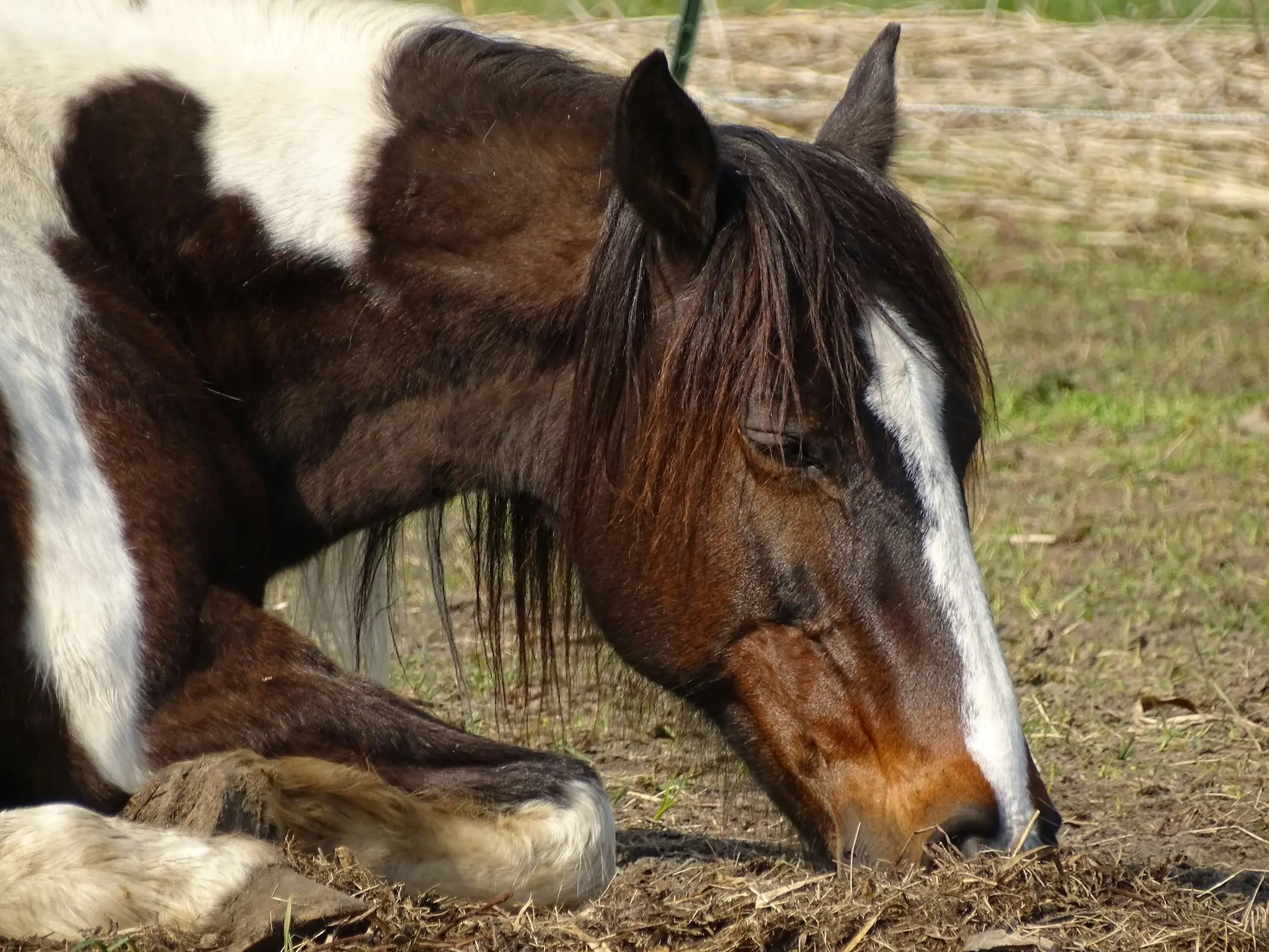
Yes, horses sleep standing up. They can lock their legs and doze for hours without falling over. The catch is that standing sleep is only the light kind. For REM sleep a horse has to lie down, and one that never does will eventually start buckling at the knees.
How the Standing Trick Works
Horses have what anatomists call the stay apparatus: an arrangement of ligaments and tendons that holds the leg joints in place with almost no muscular effort.
In the front legs, check ligaments and tendons act as tension bands that keep the knee, fetlock and foot from folding once the muscles relax. The hind legs are cleverer. A ligament at the stifle hooks the kneecap over a ridge on the end of the thigh bone, and because the stifle and hock are linked so that they can only bend together, locking one locks the other. That is why a dozing horse stands square on three legs with the fourth hind leg cocked and resting on its toe. Every so often it shifts and rests the other one.
For a prey animal this is a very good deal. A horse asleep on its feet is a second or two from a gallop. A horse flat out on the ground has to get half a ton upright first.
The Catch: REM Sleep Needs the Ground
Horse sleep comes in the same two broad kinds as ours. Slow-wave sleep is the lighter, quieter kind, and a horse can do it standing with its head low, ears slack and bottom lip drooping. REM sleep is the deep kind in which the body’s muscles go limp, and no leg-locking system can hold up a horse whose muscles have switched off.
So REM only happens lying down: either flat out on one side, or upright on the chest with the legs folded underneath and the muzzle propped on the ground, like the horse in the picture above.
Across the studies pulled together in a 2022 scientific review, horses averaged a little under four hours of sleep in 24, and only about 40 minutes of that was REM.
Those figures come from a review of equine sleep research by Linda Greening and Sebastian McBride, who are careful to say that most studies are small and mostly record at night. The pattern is consistent though. Horses sleep in many short bursts rather than one long stretch, mostly in the dark hours, and a full sleep cycle lasts around 40 minutes against roughly two hours in a human. The REM portion arrives in sequences a few minutes long.
Forty minutes a day does not sound like much. It is still not optional.
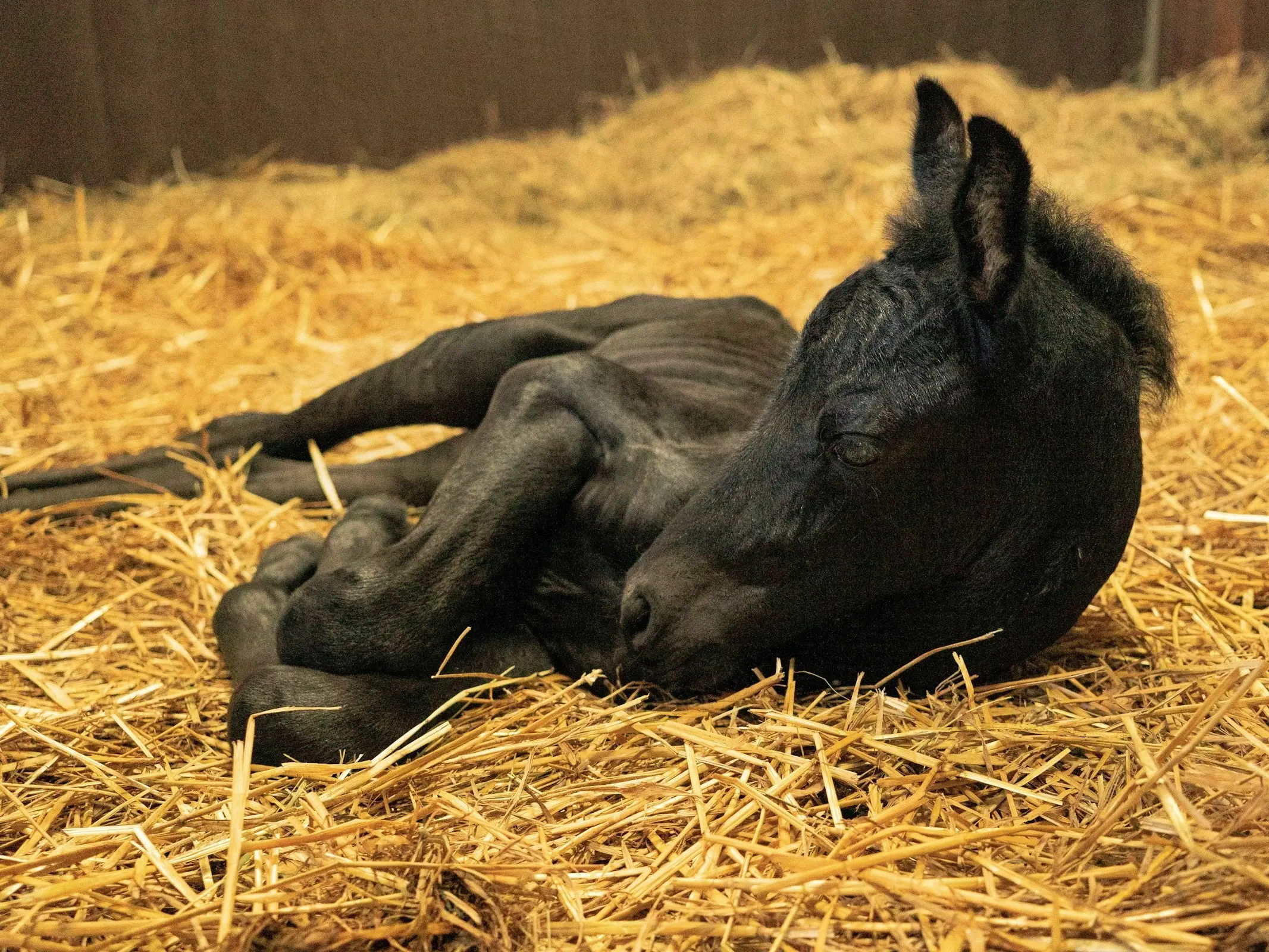
Someone Has to Keep Watch
Watch a group of horses in a field at rest and you will rarely see all of them down at once. Some lie flat, some stand over them, and they swap. Researchers describe it as a sort of rota for group vigilance, and it is the reason a horse sleeps better with company it trusts. In one of the studies in the review, horses moved from a pasture group into single stables slept noticeably less.
Foals do things differently. They spend far more of the day flat out than adult horses do, usually with the mare standing guard above them.
What Stops a Horse Lying Down
A horse has to feel safe and comfortable enough to go down, and confident that it can get back up. The usual reasons one stops:
- Pain. Arthritis and sore feet make lying down and, worse, getting up again a struggle. Old horses are the classic case.
- Thin bedding. Studies found that bedding less than about 10 cm (4 inches) deep significantly reduced lying time, and that horses lay down more on straw than on wood shavings.
- Not enough room. Larger stables were linked to longer bouts of lying down. A horse that fears getting stuck against a wall will stay on its feet.
- Feeling unsafe. A new yard, a lost companion, an aggressive neighbour, isolation, or a noisy barn with the lights left on all night.
If you are setting up a stable, our pages on stabling and general horse care cover the basics. Deep bedding does more than look generous.
What Sleep Deprivation Looks Like
A horse can get by for several days on standing sleep alone. After that the REM debt starts to show, and the signs are quite specific:
- The horse dozes off, its head sinks lower and lower, and its knees start to fold.
- It catches itself with a jolt, or it doesn’t and goes down onto its knees or nose.
- Unexplained scuffs and scabs appear on the fronts of the fetlocks and knees, or on the face.
- It is drowsy and dull during the day, sometimes dozing mid-groom or while tied up.
- The bed is undisturbed in the morning and there is never shavings or mud on its sides.
What is happening is that the horse slips into REM while standing, the muscles let go, and down it starts to go. For years these horses were called narcoleptic. Researchers at Ludwig Maximilian University of Munich who recorded affected horses overnight came to a different conclusion: in most adult horses the collapses are a REM sleep deficit caused by not lying down. In their study of about three dozen such horses, individuals collapsed between 4 and 199 times in a single 24-hour recording, and in about 86 percent of cases a REM phase was under way during or just before the collapse. True narcolepsy does exist in horses, but it is rare.
What to Do About It
Call your vet. A horse that buckles or collapses needs a proper examination first, because heart and neurological problems have to be ruled out, and because pain is one of the commonest causes and can often be treated.
After that it is detective work. A cheap camera in the stable overnight will tell you whether the horse lies down at all. Then look at the list above: more bedding, a bigger stable or more turnout, a calm companion within sight, a move away from the horse that bullies it over the partition. Many horses start lying down again once the reason they stopped is found.
Quick Answers
How long do horses sleep? Around three to four hours in 24 on average, in short bouts, though the figure varies a good deal between horses and between studies.
Is it bad if my horse lies down a lot? A horse flat out in the sun, breathing easily, that gets up when you approach is just enjoying itself. A horse that is down for much longer than usual, keeps getting up and down, or looks uncomfortable is a different matter: read our guide to rolling and colic and ring your vet.
Do zebras and donkeys do the same? They are built on the same plan, and a photograph of a zebra or a donkey flat out asleep is not hard to find. More on the relatives in zebras, horses and donkeys.