Nosebands
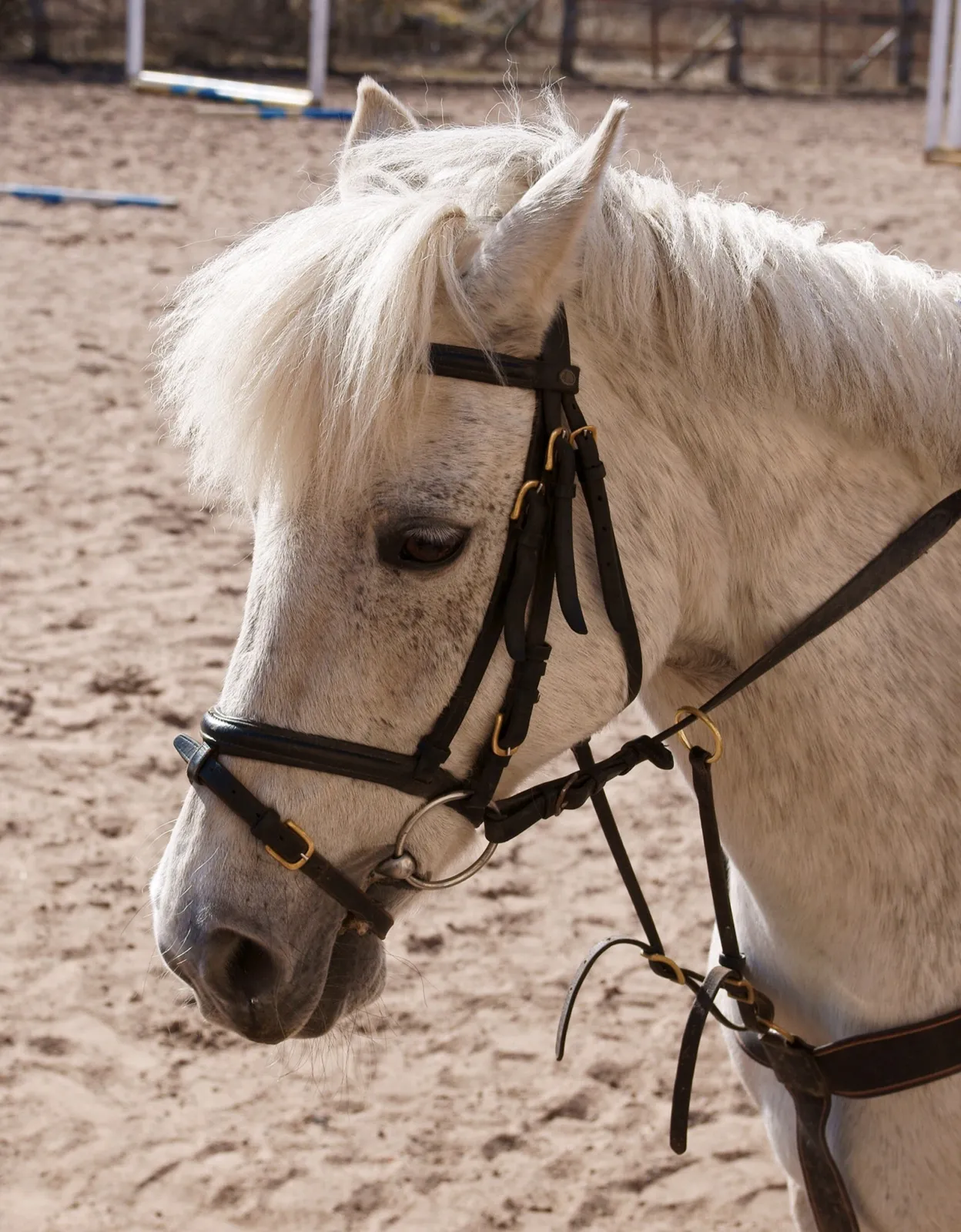
A noseband is the strap of the bridle that goes around the horse's nose. A plain one mostly finishes the look of the bridle and gives a standing martingale something to fasten to; other designs are meant to discourage the horse from opening its mouth wide or crossing its jaw. Whatever the type, a horse wearing one should still be able to chew, lick and swallow.
The main types
| Type | What it is for |
|---|---|
| Cavesson (plain or French) | The standard English noseband, sitting below the cheekbone; anchors a standing martingale |
| Flash | A cavesson with a thin second strap that passes in front of the bit and buckles under the chin, to keep the mouth more closed |
| Drop | Sits lower: the front rests on the nasal bone and the back buckles below the bit, in the chin groove |
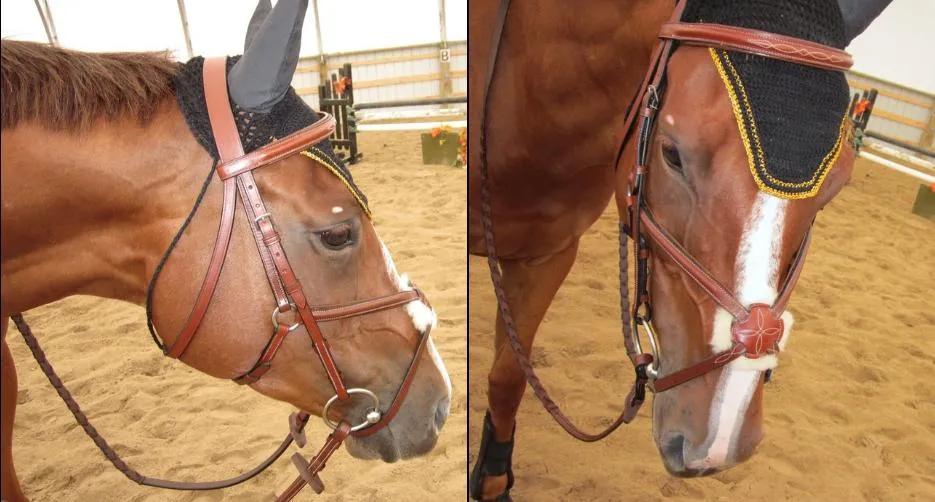
| Grackle (figure-eight) | Two straps that cross on the bridge of the nose, one above and one below the bit; popular in jumping, eventing and racing |
| Crank | A padded cavesson with a leverage buckle that can be pulled much tighter than an ordinary buckle |
The cavesson hangs from its own sliphead, so it can be raised or lowered without moving the bit. The flash strap runs from a loop at the front of the cavesson; a standing martingale should go only on the upper strap. The drop has to stay high enough to rest on bone: lower down, over the soft cartilage at the end of the nose, it can interfere with breathing. The grackle’s crossing point usually carries a small pad, and the design leaves the nostrils free to widen, which suits galloping horses.
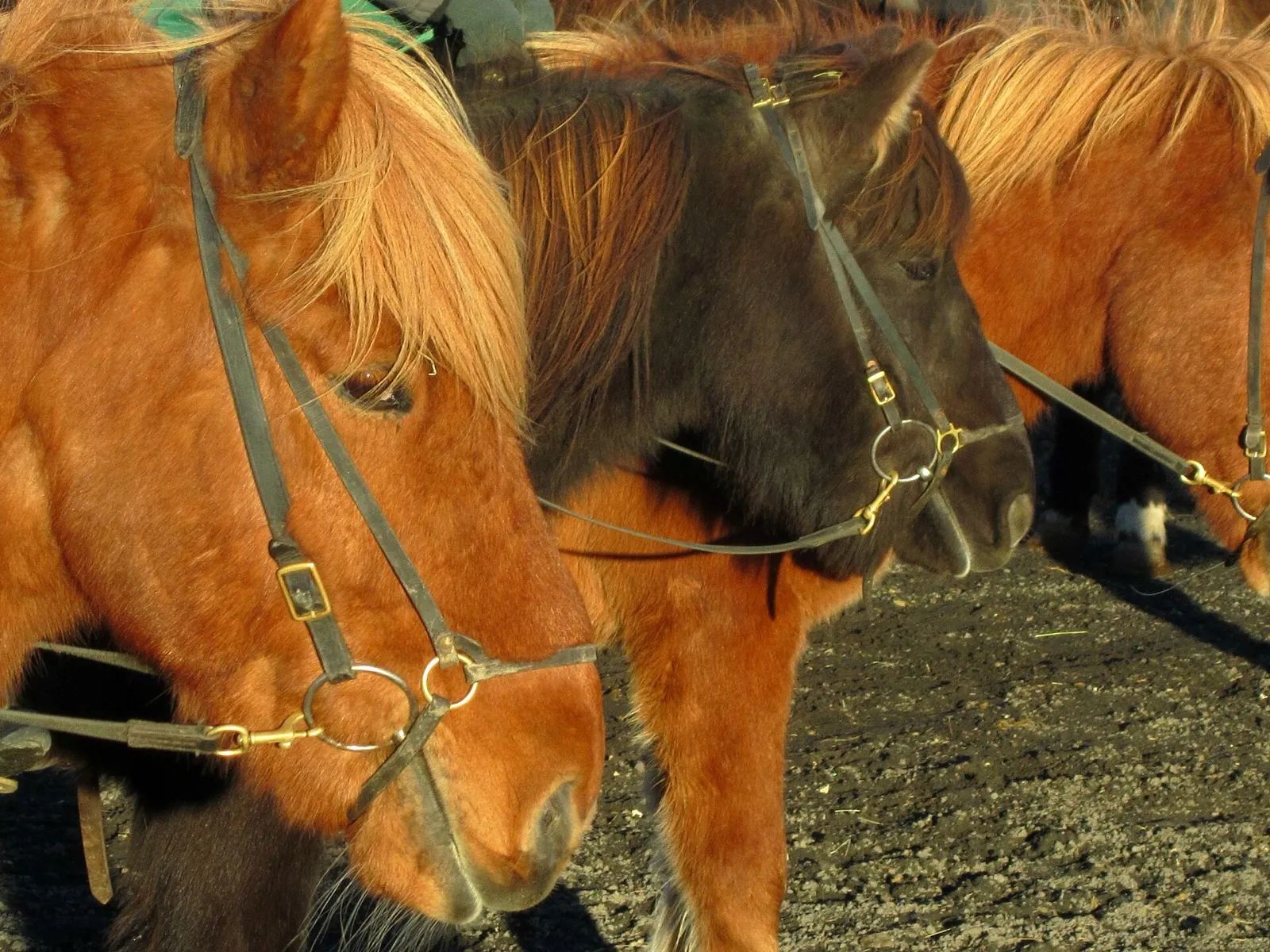
Western bridles normally have no noseband at all. In roping and speed events a strong noseband may be used to support a tie-down, but some show rules forbid any bare metal touching the horse’s head.
Where it should sit
The Pony Club’s guidance in Britain gives a clear rule for each design:
- Cavesson: leave about a finger’s width (1.5 to 2 cm) between the bottom of the facial crest, the bony ridge along the cheek, and the top of the noseband.
- Drop: the front should be fully supported by bone, with the back in the chin groove.
- Flash: the upper strap fits like a cavesson, the lower strap like a drop.
- Grackle: the upper strap above the bottom of the facial crest, on the flat of the cheek; the lower strap in the chin groove; the central pad as high as possible.
The two-finger check
For every type, you should be able to slide two adult fingers, one on top of the other, between the noseband and the front of the nose. Check on the bony front of the nose, not at the side of the face, where fingers slip in even when the noseband is far too tight. Because fingers vary, the International Society for Equitation Science (ISES) designed a taper gauge based on two average adult fingers, and its position statement calls any noseband tighter than that restrictive.
Many are. A 2017 study that measured 737 horses at eventing, dressage and performance hunter competitions in Ireland, England and Belgium with the ISES gauge found 44 percent with no room for even one finger, and only 7 percent at the two-finger mark. In a 2016 trial on 12 horses wearing a double bridle, a crank noseband done up with no space raised heart rate and eye temperature, both signs of stress, cut chewing and stopped licking altogether; once it came off, the horses yawned, licked and swallowed more than before (Fenner and colleagues, 2016).
What the federations say
Since May 2025 stewards at FEI events in every discipline check noseband tightness with an official measuring device about 1.7 cm thick, slid under the noseband over the nasal bone. The rule covers every type of noseband and both straps of a flash or grackle. A noseband that fails before the class must be loosened before the horse can start; one that fails the check after the class means elimination and a yellow warning card. Under the FEI’s dressage rules a snaffle bridle may carry a cavesson, drop, flash, crossed or combined noseband, while a double bridle may only have a plain cavesson. Some national federations go further: Denmark made nosebands optional in dressage from January 2025. Rules change, so check your own rulebook before a show.
Signs of trouble and care
Rubs, bald patches or marks on the nose and under the chin, a horse that can’t lick or chew, and fussing as soon as the bridle goes on all suggest a noseband that is too tight or in the wrong place. A horse that keeps opening its mouth is telling you something; ISES warns that a tight noseband can hide problems rather than solve them. Have its teeth and bit fit checked and ask your instructor or a qualified saddler for help, rather than tightening the strap. Keep the leather clean and supple and check the buckles and keepers (see how to clean tack).
Worth knowing
The grackle is named after Grakle, the horse who won the 1931 Grand National at Aintree; the spelling of the noseband drifted over the years.
Related tack
A noseband is part of the bridle and works closely with the bit. A standing martingale fastens to the cavesson, and nose-based designs without a bit are covered under hackamores and bitless bridles.
Top image from kallerna under the CC BY-SA 3.0 license

Image from Christine Zenino from Chicago, US under the CC BY 2.0 license

Image from Danielle M. under the CC BY 3.0 license
