Martingales and Tie-Downs
A martingale is a strap, or set of straps, that runs from the girth up between the front legs to the reins or the noseband. It stops a horse throwing its head so high that the bit no longer works and the rider risks a knock in the face. A well-adjusted martingale does nothing at all while the horse carries its head normally.
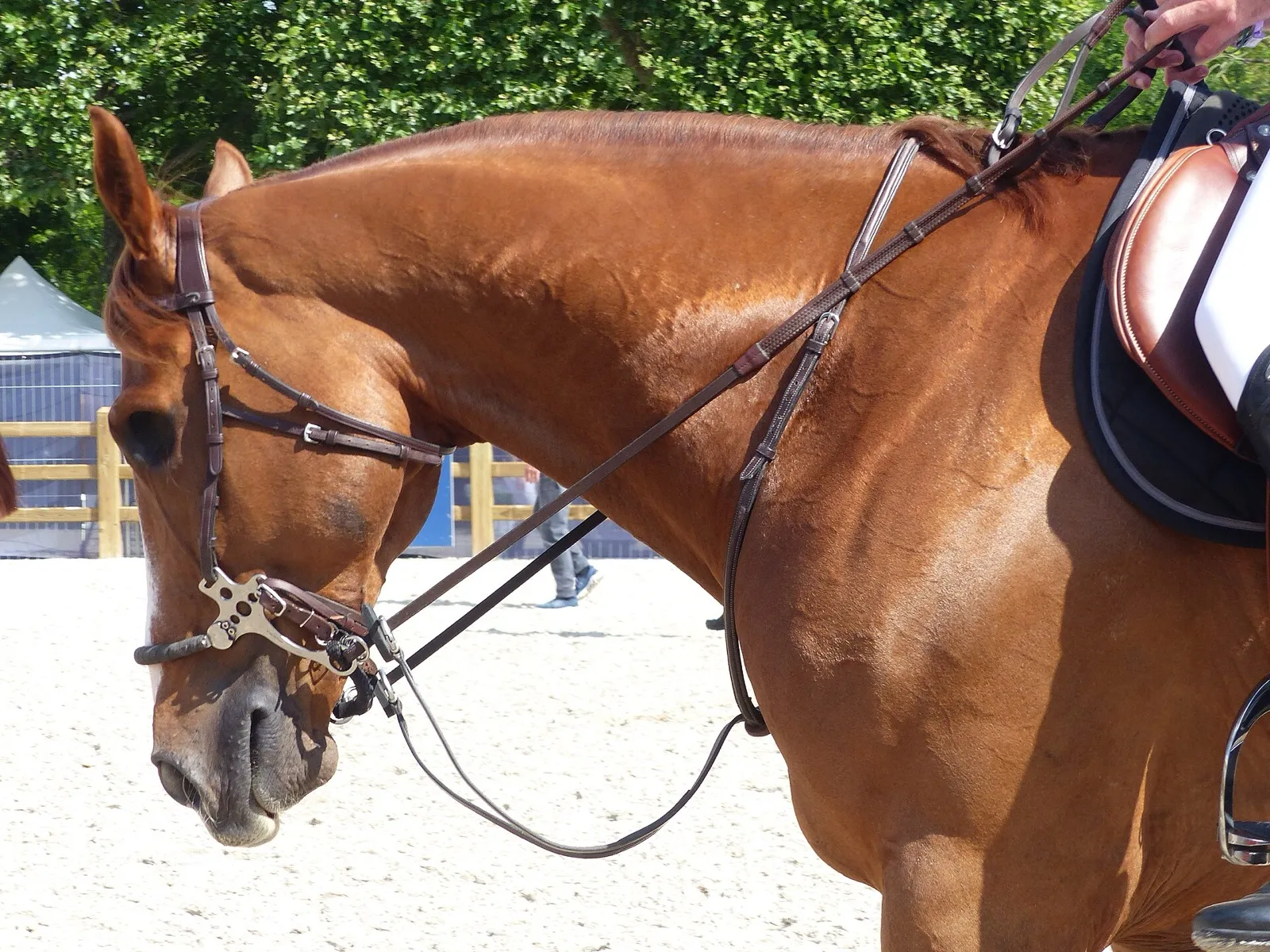
Parts
Most English martingales have a strap from the girth that passes between the front legs, a neck strap that holds it up (and gives the rider something to grab in an emergency), and a small rubber ring that holds the two together where they cross. What happens at the top end is what makes each kind different.
The main types
| Type | What it is for |
|---|---|
| Running martingale | The strap splits into two, each ending in a ring that one rein runs through. If the head goes too high, the rings pull the reins, and so the bit, downward. Jumping, eventing, hunting, racing |
| Standing martingale | A single strap from the girth to the back of the noseband. It limits how high the head can go and acts on the nose, not the mouth. Show hunters, polo, hunting |
| Irish martingale | A short strap under the neck with a ring at each end for the reins. It has no effect on the head; it keeps the reins from flipping over the head if the horse stumbles or the rider falls. Mostly racing |
| German martingale | Straps from the chest run through the bit rings and clip to rings on the reins, adding leverage. A schooling aid, close cousin of the British Market Harborough |
| Tie-down | The western version of a standing martingale: a strap from the cinch or breast collar to a noseband, often of rope or leather. Barrel racing, roping and other timed events |

How each should fit
Running martingale. With the horse’s head in its normal position, the reins should run in a straight line from the bit to the rider’s hand, with the rings hanging slightly slack. If the martingale bends the reins down all the time, it is too short. Always use rein stops, small leather or rubber stops on each rein between the ring and the bit, so a ring cannot slide forward and catch on the bit or the rein buckle. The Pony Club and British Eventing, among others, require them. On a double bridle or pelham, the martingale goes on the snaffle rein, never the curb rein.
Standing martingale. With the horse standing normally, you should be able to push the strap up under the neck until it touches the throat. Fasten it only to a plain cavesson noseband, or the cavesson part of a flash. Never attach it to a drop or figure-eight noseband, where it would pull down on the soft part of the nose, or to the bit.
Tie-down. It should put no pressure on the nose while the head is in its normal position, and come into play only when the head goes up.
Neck strap. Leave room for a hand between it and the withers (the ridge at the base of the neck), so it does not press as the horse moves.

Safety points
- A standing martingale or tie-down cannot be released in a hurry. Adjusted too short, it stops the horse using its head and neck to balance, which matters over fences and when a horse stumbles.
- Unfasten a tie-down or standing martingale before crossing water or swimming. A horse that slips or falls in water and cannot lift its head can drown very quickly.
- A martingale is not a substitute for training. If a horse fights it, look for the cause: teeth, a sore back, a poorly fitting saddle or bit, or heavy hands. Ask your vet, saddle fitter or instructor. Constant pulling against a standing martingale can build the wrong muscles under the neck.
- Check the stitching at the rings and the buckles often, and clean and condition the leather with the rest of your tack (how to clean tack).
Competition rules
Rules change, and they differ between sports, countries and levels, so always check the current rule book before you ride. In broad terms:
- Dressage. Martingales are not allowed in the competition arena.
- Eventing. A running martingale is allowed in the jumping phases, standing martingales are not, and many organizers insist on rein stops.
- Show jumping. Under FEI (international) rules, running martingales are allowed in all classes; standing martingales only in certain national and children’s competitions.
- American hunters. Standing and running martingales are allowed over fences, but not in under saddle or hack classes on the flat.
- Racing. Running and Irish martingales are common.
- Western. Tie-downs are common in timed rodeo events but are not allowed in most judged western classes.
- German martingales and Market Harboroughs are training aids and are barred from most competitions.
Worth knowing
Many breastplates have a ring at the chest for a running martingale attachment, so riders who need both can use one piece of tack. See breastplates.
Related tack
A martingale works through the reins, the bit or the noseband, so it should be chosen along with the bridle it is used on. Our bridle terminology page names every strap.
Top image from Tsaag Valren under the CC BY-SA 4.0 license

Image from Serge Melki from Indianapolis, USA under the CC BY 2.0 license

Image from Amélie Tsaag Valren under the CC BY-SA 4.0 license
