Breastplates and Breast Collars
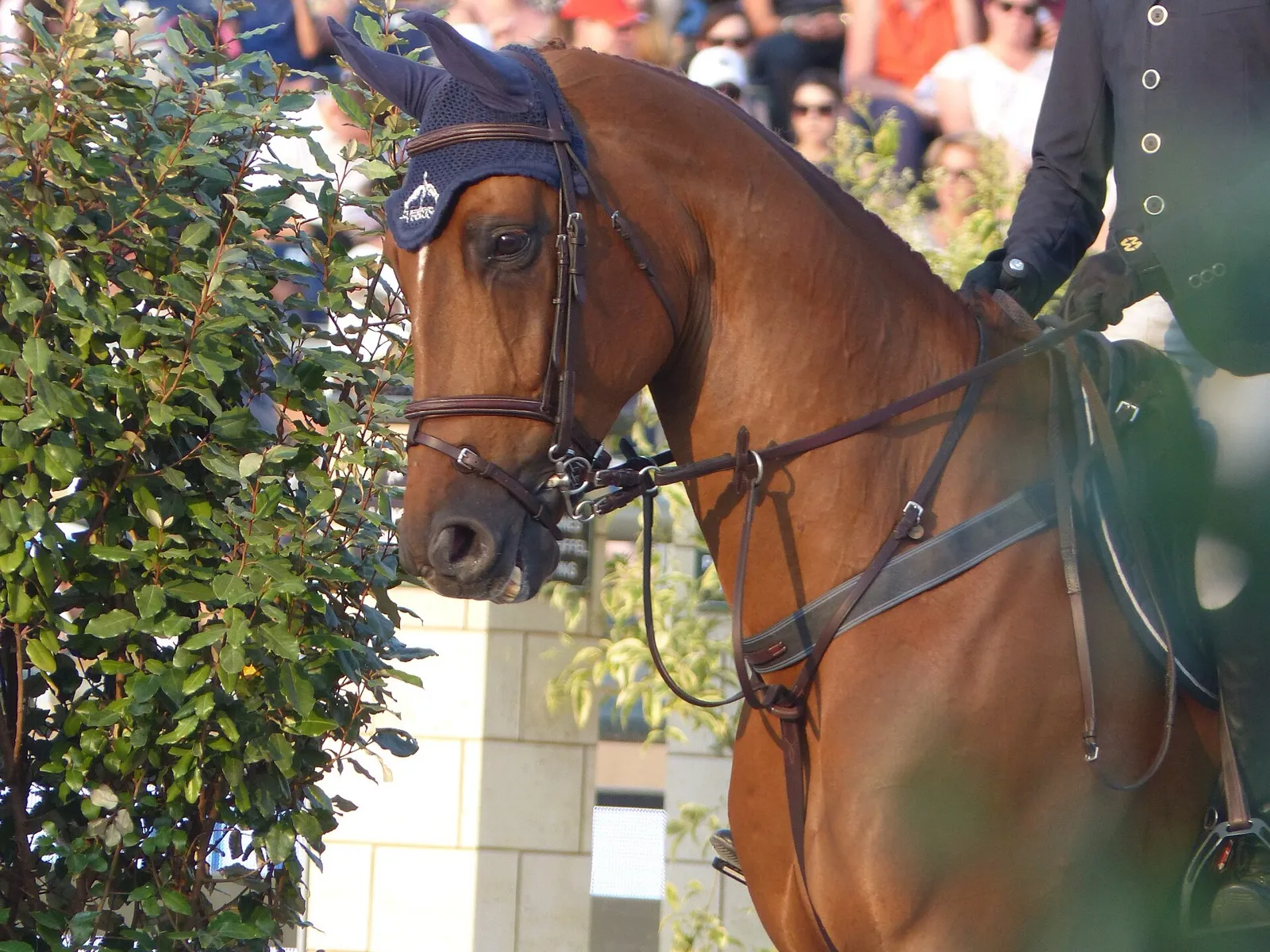
A breastplate is a set of straps across the front of the horse that keeps the saddle from sliding back. Western riders call it a breast collar. It earns its keep on steep hills, out hunting, across country and in fast work, and on lean horses whose saddles tend to slip toward the loins.
What it does
When a horse climbs, jumps or gallops, its shoulders push forward while the saddle wants to stay behind. A girth alone may not hold it, especially on a lean horse whose body narrows behind the girth. A breastplate anchors the front of the saddle to the chest so it stays where the saddle fitter put it.
It is also a backup. If a girth or billet breaks, a breastplate can hold the saddle long enough for the rider to pull up and get off.
The main types
| Type | What it is for |
|---|---|
| Hunting breastplate | A neck strap with two straps to the D-rings at the front of the saddle and one strap between the front legs to the girth. Hunting, show hunters, trail riding, eventing |
| Five-point breastplate | Like the hunting style, plus a strap on each side to the girth under the saddle flap. Popular in eventing and jumping for extra security |
| Elastic jumping breastplate | A strap of strong elastic across the base of the neck, fixed to the saddle’s D-rings. Lets the shoulders fold freely over fences |
| Racing or polo breastplate | A horizontal strap around the chest from girth to girth, held up by a strap over the withers. Polo, racing, cross-country |
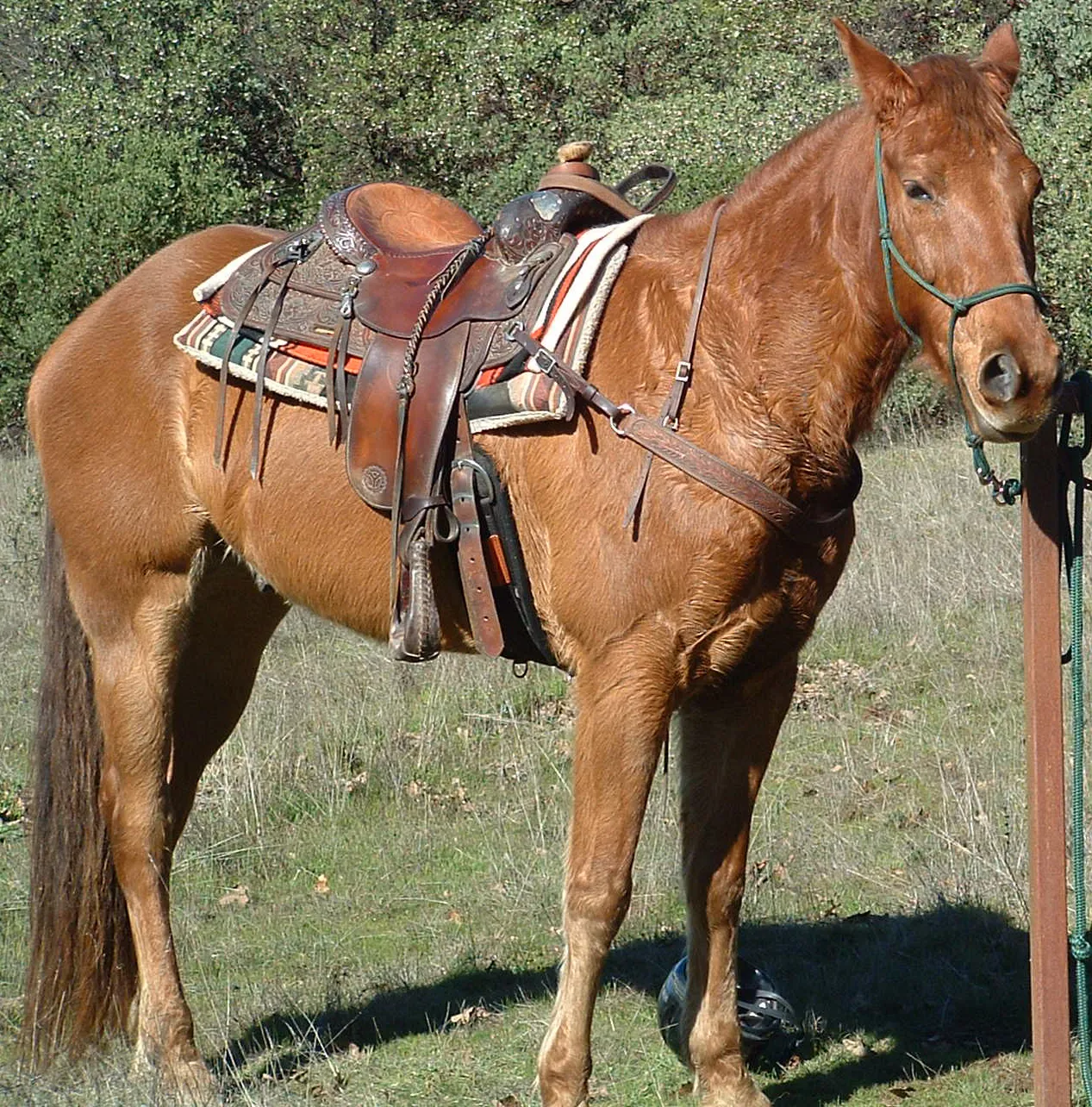
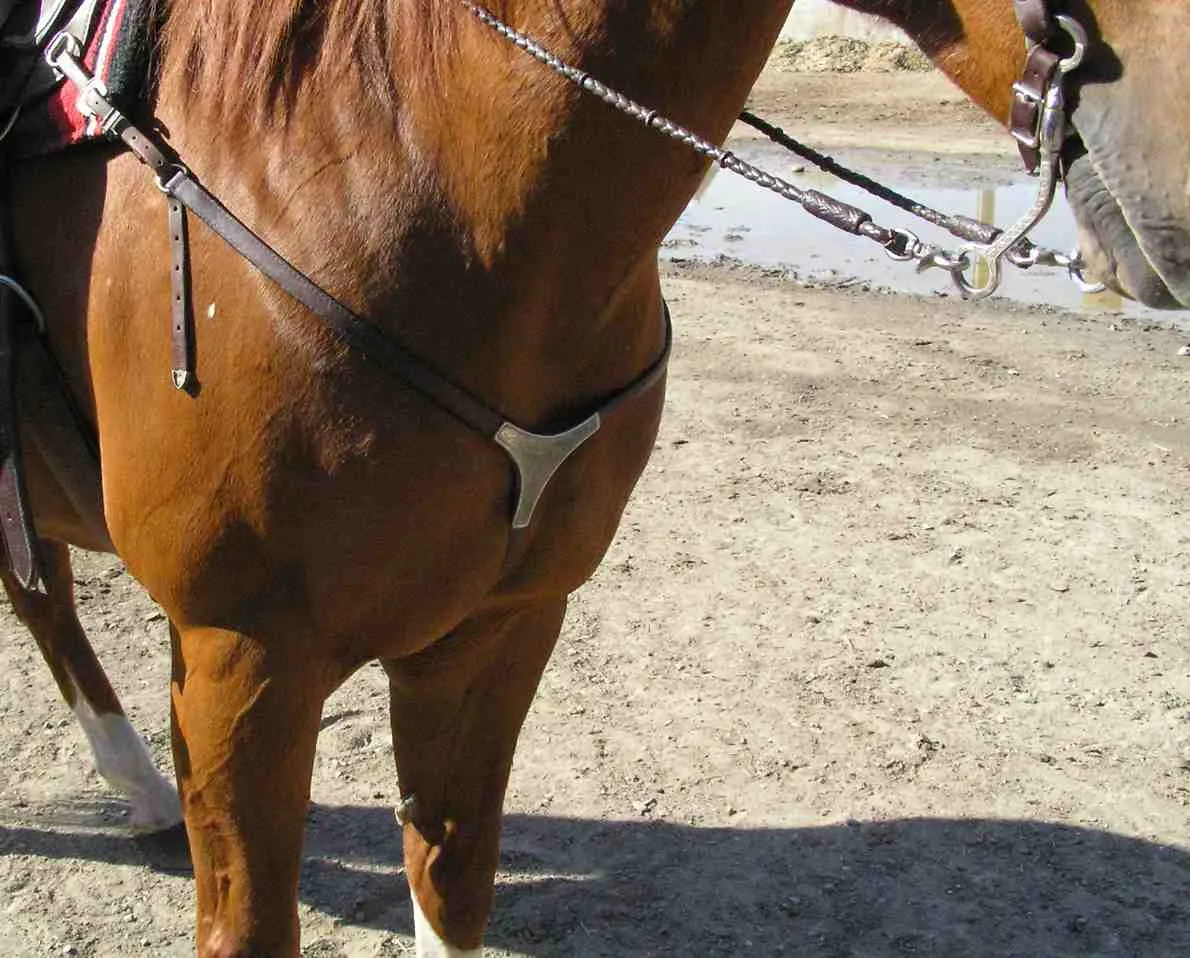
| Western breast collar | A wide strap across the chest fixed to the front rigging dees, usually with a strap between the legs to the cinch and sometimes one over the withers. Ranch work, roping, trail and western shows |
Many English breastplates have a ring at the center of the chest where a running martingale attachment can be clipped, so one piece of tack does two jobs. See martingales for how that part works.
How it should fit
- Height. The chest straps should cross above the point of the shoulder, the bony knob at the front of the upper arm, so the shoulder can swing freely. They must also stay clear of the windpipe at the base of the throat, even when the horse lowers its head.
- Room at the chest. You should be able to slide a fist between the breastplate and the chest, but not much more.
- Over the withers. A neck or wither strap needs room for about a hand between it and the withers (the bony ridge where the neck meets the back), so it does not press as the horse moves. Guides differ a little on the exact gap; the aim is no pressure at rest.
- Between the legs. The strap to the girth or cinch should have some slack. Its buckle should sit where it cannot rub the skin between the front legs.
- Pull. A well-adjusted breastplate is quiet most of the time and tightens only when the saddle starts to move. If it is tight all the time, it is too short, and it may drag the saddle forward onto the withers.
Signs of a poor fit include rubbed hair or sores on the point of the shoulder, the chest or between the front legs, a shorter stride, and a horse that resents stretching its neck down or folding over a jump.
A breastplate is not a cure for a saddle that does not fit. If the saddle slides back on every ride, ask a qualified saddle fitter to look at it, and read our guide on how to fit a saddle.
Safety and care
The D-rings at the front of an English saddle carry a lot of strain in a breastplate. Check that they are firmly fixed and that the stitching around them is sound. Elastic loses its stretch and perishes with age and sweat, so look closely at elastic panels and the stitching where they meet the leather. Clean and condition the leather as you would a bridle, following our tack cleaning guide, and keep buckles free of grit that can rub.
Worth knowing
In driving, a breast collar is something else entirely. It is the strap the horse pushes into to pull the vehicle, not a strap that holds a saddle in place. Our page on harness explains the difference between a breast collar and a full collar.
Related tack
A breastplate stops a saddle going back; a crupper stops it going forward. Both work with the girth and the saddle itself, and English breastplates often carry the martingale.
Top image from Tsaag Valren under the CC BY-SA 4.0 license

Image from Robin Mathias under the CC BY 2.0 license

Image from BLW, public domain
