Horse Teeth Can Tell Their Age: How to Estimate Age by Teeth
You can tell a horse's age from its teeth to within a few months up to the age of five, to within a year or two between five and ten, and only roughly after that. The young horse's teeth arrive on a schedule. The older horse's teeth simply wear, and wear depends on the horse.
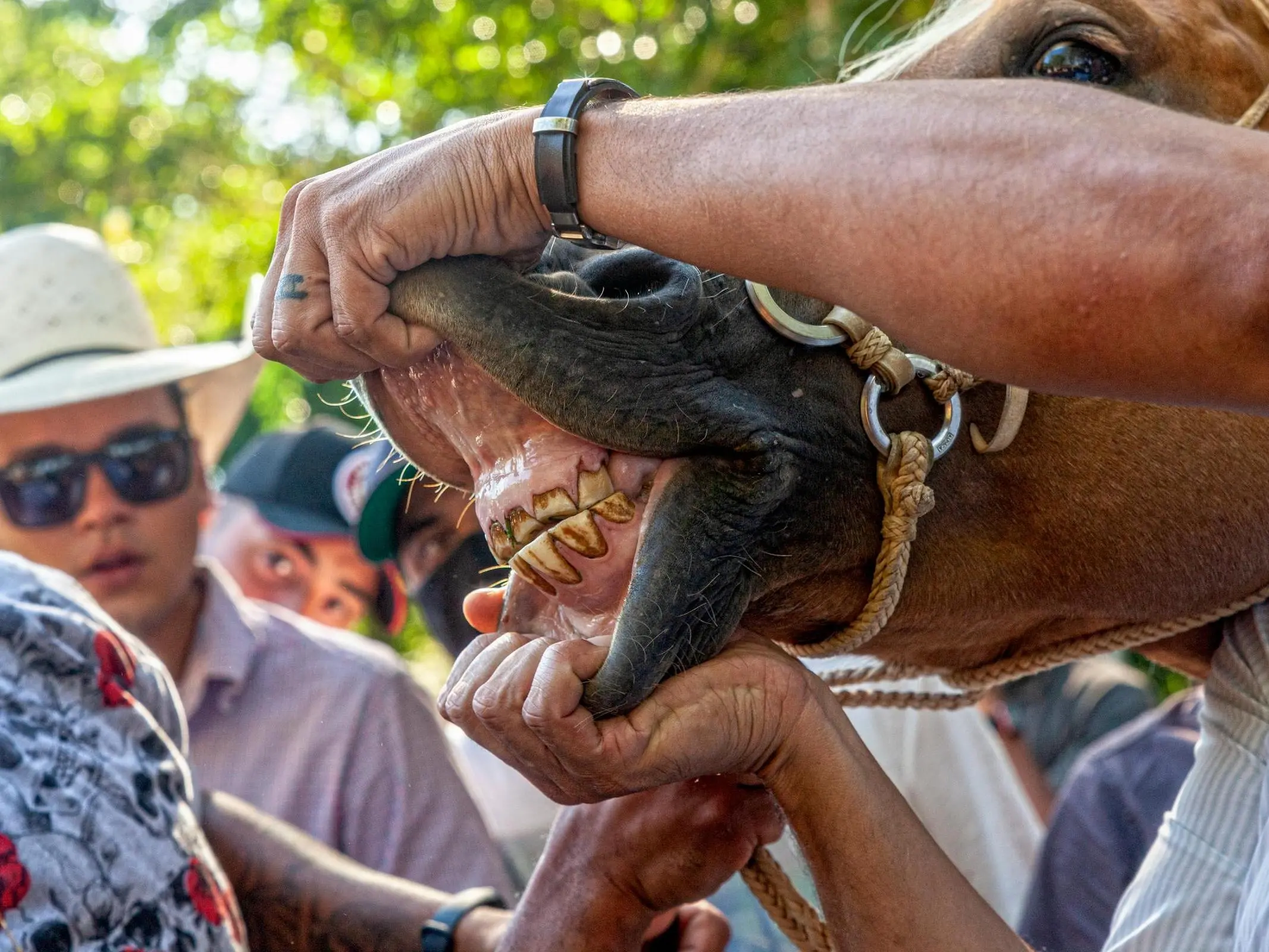
Ageing is done almost entirely from the incisors, the twelve front teeth: six on top and six below. They are named in pairs from the middle outwards as centrals, intermediates and corners. An adult horse has between 36 and 44 teeth in all, depending on whether it has canines and wolf teeth, but the cheek teeth are too far back to be much help.
Stand at the horse’s shoulder, not in front. Part the lips gently to see the front and side of the bite; to see the biting surfaces you will need the mouth open, which is best learned from someone who does it every day. If the horse objects, leave it to the vet.
Birth to five: reading the calendar
Foals get temporary (milk) teeth, which are small, white and scallop-shaped with a distinct neck at the gum. Permanent teeth are bigger, squarer and more yellow. The changeover is the most reliable clock a horse has.
| Age | What you see |
|---|---|
| First week | Central milk incisors through |
| 4–6 weeks | Intermediate milk incisors |
| 6–9 months | Corner milk incisors |
| 2½ years | Permanent centrals replace the milk centrals |
| 3½ years | Permanent intermediates |
| 4½ years | Permanent corners |
| 4–5 years | Canines (tushes), mostly in males |
| 5 years | A “full mouth”: all permanent teeth present |
The old horseman’s version for foals, eight days, eight weeks and eight months, is close enough to remember. Wolf teeth, the small extra teeth in front of the upper cheek teeth, appear at around five or six months if the horse has them at all.
So a horse with four big permanent incisors in the middle and small milk teeth at the corners is a three-and-a-half-year-old, give or take a few months, and you can say so with some confidence.
Five to ten: cups and stars
Once all the permanent teeth are in, you are reading wear on the biting surface.
- Cups. Each new incisor has a dark hollow in the middle of its table. As the tooth wears down, the hollow gets shallower and disappears. By tradition the cups go from the lower centrals at about six, the lower intermediates at seven and the lower corners at eight, with the upper teeth following at about nine, ten and eleven. A horse with no cups left is “smooth-mouthed”.
- Dental stars. As the cup wears away, a second mark appears between it and the front edge of the tooth: first a dark yellow-brown line, later a rounder spot nearer the centre. This is the top of the pulp cavity, filled in with darker dentine. Stars show first in the central incisors, from about five or six by some accounts and a few years later by others.
- The seven-year hook. A small overhanging hook often forms on the back of the upper corner incisor at about seven, wears away, and may come back in the early teens. It is famous and unreliable.
Ten and over: grooves, shapes and angles

Image from Garry
- Galvayne’s groove. A dark vertical line on the outer face of the upper corner incisor. By the textbook it appears at the gum at about ten, reaches halfway down the tooth at fifteen and the whole length at twenty, then grows out from the top, so that it is half gone at twenty-five and gone at thirty. It is named after Sidney Galvayne, a nineteenth-century horseman who promoted it as a method.
- Shape of the tables. Seen from above, the biting surfaces of the lower incisors are wide ovals in a young horse, become rounder in the early teens, and then triangular, deeper from front to back than they are wide, in old age.
- Angle of the bite. From the side, a young horse’s upper and lower incisors meet almost upright, like a pair of pliers. With age they slant further and further forward, and the teeth look longer as the gums recede. That is where “long in the tooth” comes from.
How accurate is it, really?
Less than the neat tables suggest, and the profession has said so itself.
In 1995 a British team published a series of studies on 434 Thoroughbreds whose ages were known from their papers. Experienced clinicians were asked to age them by their teeth. Their estimates disagreed with each other and with the truth, and the errors grew as the horses got older; the authors called ageing an older horse an informed guess. They found the hook and Galvayne’s groove of no practical value, and the dental star the best of an imperfect set of signs.
A Belgian study of 212 horses the following year came to much the same view: eruption dates and dental stars were the most dependable guides, the marks on the tables disappeared years later than the textbooks said, and the groove and hook could not be relied on. The same group went on to show that breed matters. Draft horses wore their teeth faster than trotters, and Arabians more slowly than either.
Other things shift the clock as well: gritty or sandy grazing, a diet of soft feed, crib-biting, and the shape of the individual mouth.
A fair summary:
| Age of horse | How close teeth will get you |
|---|---|
| Under 5 | Within a few months |
| 5 to 10 | Within a year or two |
| 10 to 20 | “Early teens”, “mid-teens”, “late teens” |
| Over 20 | “Old”, honestly |
What to do with this
- Trust paperwork over teeth. A passport, registration papers or a microchip record with a foaling date beats any mouth. Where the paperwork and the teeth disagree badly in a young horse, ask questions.
- Be wary of precise claims about older horses. “Rising nine” on an advert and a smooth mouth with a long groove are not the same horse. A pre-purchase vetting will include the vet’s own estimate.
- Have the teeth checked for their own sake. A dental examination at least once a year matters far more to the horse than its birthday does. Sharp edges, hooks and worn or missing teeth affect how it eats and how it goes in a bridle.
Once you have an age, the age calculator will turn it into human years, which is not science either but is a good deal more fun. And if the horse is losing weight as its teeth wear, body condition scoring will help you keep track.