Things Horses Are Weirdly Afraid Of: A Field Guide to Plastic Bags, Puddles and That One Rock
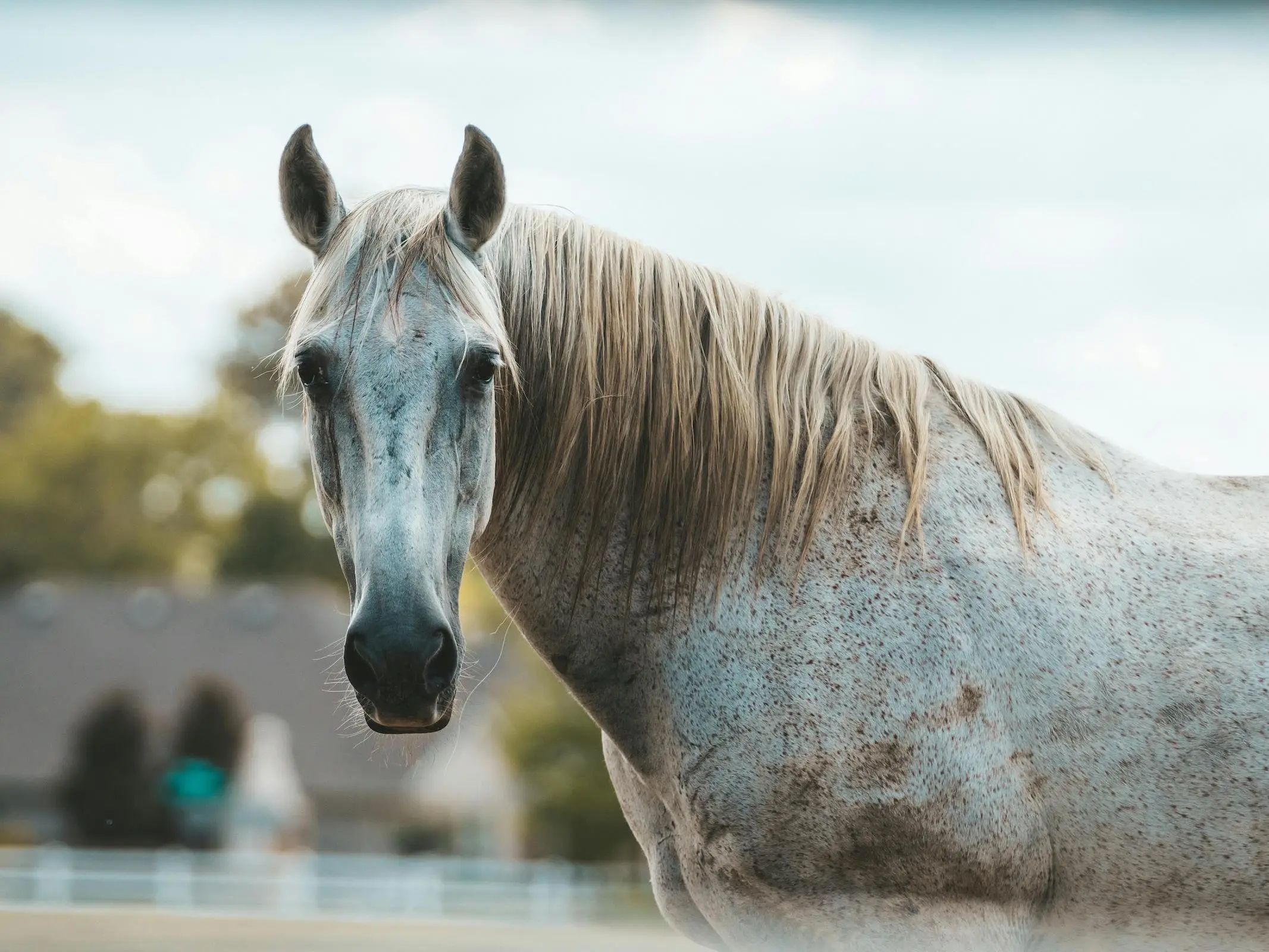
A horse weighs about half a ton and can be put to flight by a crisp packet. This is not stupidity. It is the survival kit of a prey animal that sees nearly all the way round itself, notices movement before detail, and runs first and thinks afterwards. Below is a field guide to the most commonly sighted terrors, with the threat level as assessed by the horse and by everybody else, followed by why they work and what to do about them. The Latin is for the look of the thing.
The Common Plastic Bag
Saccus horribilis
Habitat: Hedges, fence lines, the hand of the person you asked to hold your horse.
Field marks: Pale, shapeless, moves without legs. Rustles.
Threat level (horse): Apex predator.
Threat level (actual): Contained a sandwich.
The bag is the complete package: it appears suddenly, moves unpredictably, makes a noise and has no recognisable outline. There is a reason researchers who study fear in horses keep reaching for one.
The Puddle
Aqua profunda
Habitat: Gateways, the only way home.
Field marks: Flat, shiny, shows the sky where the ground should be.
Threat level (horse): Bottomless.
Threat level (actual): Two centimetres.
In the horse’s defence, a reflective surface gives no clue about what is underneath it, and a horse cannot see the ground directly below its own nose. The same animal will, of course, gallop through a river if its friends are on the other side.
That One Rock
Saxum suspectum
Habitat: Exactly where it has been for the last 10,000 years.
Field marks: Rock-shaped. Rock-coloured.
Threat level (horse): Under review. Has been under review since 2019.
Threat level (actual): Rock.
Passed without comment on forty rides. On the forty-first the light is different, or the horse is fresh, or the rock has simply had enough of being trusted.
The Object That Has Moved
Res translata
Habitat: The arena. Specifically, one metre to the left of where it was yesterday.
Field marks: A mounting block, jump wing, wheelbarrow or coat on a fence.
Threat level (horse): Someone has been in here.
Threat level (actual): Someone has been in here. They tidied up.
This one is a compliment to the horse’s memory. It has a detailed map of home and it has spotted an edit. On the open plains, “something is different” was worth a second look.
The Wheelie Bin on Collection Day
Receptaculum hebdomadale
Habitat: Roadsides, one morning a week.
Field marks: Upright, dark, roughly the size of a crouching animal. Was not there on the way out.
Threat level (horse): A row of them is an ambush.
Threat level (actual): Recycling.
The Patch of Sunlight
Lux in pavimento
Habitat: Indoor arena floors, barn aisles, the trailer ramp.
Field marks: A bright shape on dark ground, or a dark doorway in a bright wall.
Threat level (horse): A hole. Possibly a portal.
Threat level (actual): A window.
Hard edges between light and shade are difficult for horses to read, and their eyes are thought to adjust more slowly than ours when going from bright to dark. A trailer is, from the horse’s point of view, a small black cave. Give it a moment to look.
The Familiar Human in an Unfamiliar Outline
Homo sapiens, forma nova
Habitat: The yard, in the rain.
Field marks: Your voice, your smell, but now with a flapping poncho, a hood, an umbrella or a large box.
Threat level (horse): Whatever ate my owner is wearing her wellies.
Threat level (actual): You, with a feed sack on your shoulder.
The Far End of the Arena
Angulus terribilis
Habitat: The corner furthest from the gate, in every arena ever built.
Field marks: None visible to humans.
Threat level (horse): Something lives there.
Threat level (actual): It is the corner furthest from the gate.
Usually has a hedge, a judge’s box, a rustling tree or a door behind it. Also has the special quality of being as far as possible from the exit and the other horses, which may be the entire explanation.
The Small Equine
Equus minimus
Habitat: The paddock next door. A cart, occasionally.
Field marks: Horse-shaped but wrong-sized. See also: donkeys, llamas, pigs, a cow lying down.
Threat level (horse): It looks like us. It is not us.
Threat level (actual): A Falabella named Gerald.
Why Horses Are Like This
They are built to notice everything. A horse’s eyes are among the largest of any land mammal and sit on the sides of its head, giving a field of view of roughly 350 degrees. Only a wedge of that in front, somewhere around 65 degrees, is seen with both eyes at once. The rest is one-eyed vision that is excellent at catching movement and less good at detail and depth. There are two blind spots: directly behind, and a small zone right in front of the face and under the nose. That is why a horse raises or lowers its head to examine something, why it wants to turn and look, and why things that appear from behind get the biggest reaction.
They run first. The startle response is a reflex. A horse that stopped to consider whether the rustle in the grass was a lion did not become anyone’s ancestor. The leap sideways happens before the thinking part of the brain has a vote, and the thinking part often rules “bag” a second later. By then you are on its neck.
Their colour world is not ours. Horses see in two colours, roughly blues and yellows, where we see in three. A bright orange cone that shouts at you may barely stand out from grass for a horse, while a pale tarp on dark ground is stark.
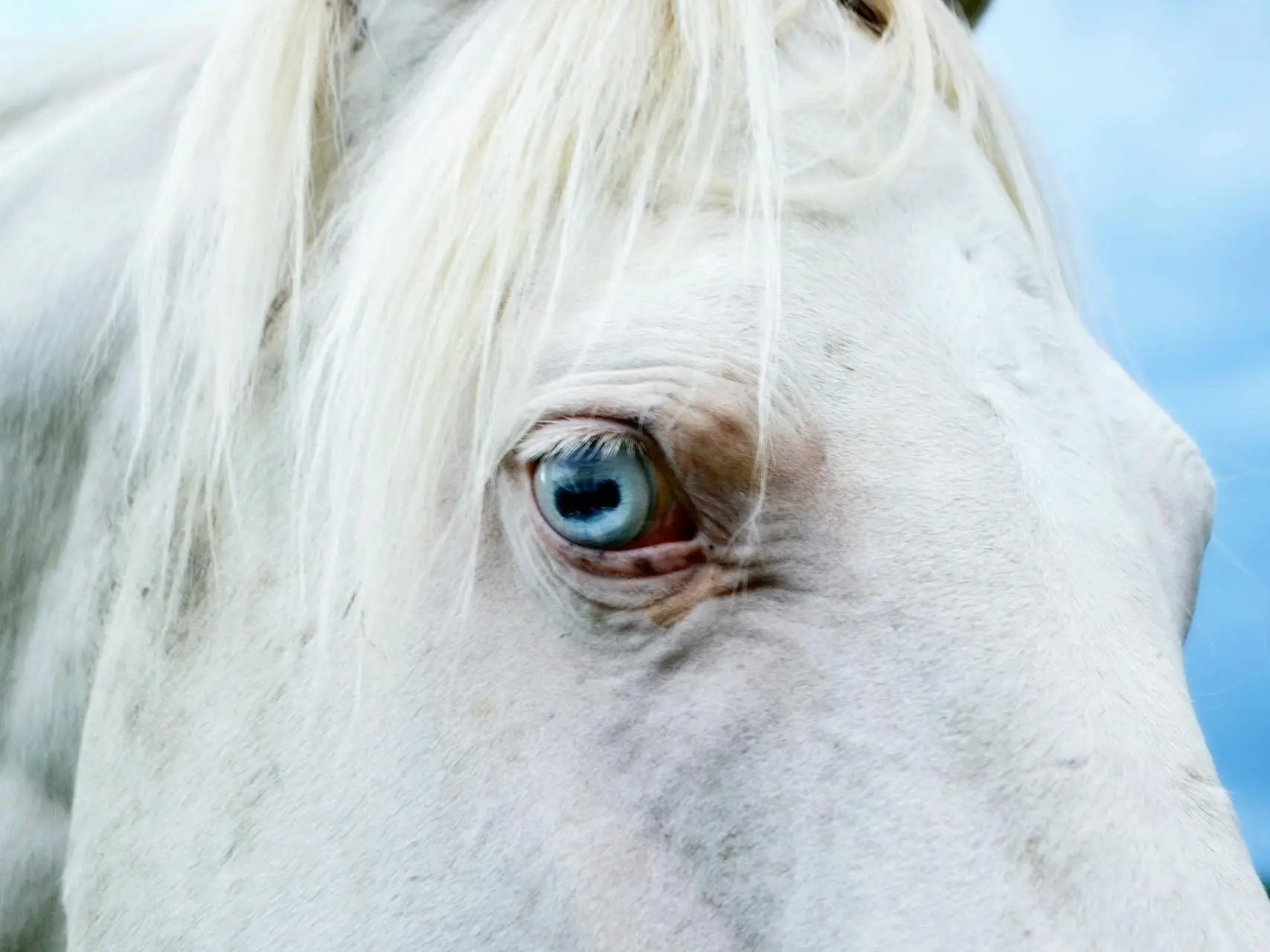
The white of a horse’s eye is a classic sign of alarm. The exception is the Appaloosa, where visible white sclera is a normal breed trait and not a comment on your plastic bag.
The “Two Brains” Myth
You will hear that a horse has to be shown everything twice, once on each side, because the two halves of its brain do not talk to each other. This has been tested. In experiments by the equine cognition researcher Evelyn Hanggi, horses that learned to recognise something with one eye covered recognised it with the other eye straight away.
So why does the horse walk past the wheelbarrow going out and spook at it coming home? Because it is a different view. It is the same object from another angle, in other light, against another background, and research on habituation shows that horses learn “this thing is safe” quite narrowly. A change of shape or colour can make an old object new again. It is still sensible to introduce things from both sides. Just know that you are showing the horse two pictures, not informing two brains.
Desensitising, Safely
The best evidence here comes from Janne Winther Christensen and colleagues, who compared three ways of teaching horses to stay calm around a frightening object. The clear winner was gradual desensitisation: start with a version of the scary thing so mild that the horse stays relaxed, and only increase it step by step when the horse is calm at the current level. Horses trained this way showed fewer flight reactions and needed fewer sessions, and every one of them got there. Simply exposing horses to the full thing until they gave up reacting worked less well, and some never settled.
In practice:
- Start small and far away. A folded bag at a distance before an open one flapping nearby. If the horse’s head goes up and its feet get busy, you have gone too fast: go back a step.
- Let the horse look. Approaching, sniffing and touching on its own terms teaches more than being held next to something.
- Reward calm, never punish fear. Punishment only confirms that the bag was bad news.
- Borrow a steady friend. Christensen and colleagues also found that inexperienced horses reacted less fearfully alongside a calm companion.
- Mind where you stand. Stay out of the path the horse would take if it jumped, wear a helmet and gloves, and work in a safe enclosed space. Our guide to handling horses safely covers the basics.
- Get help when it is beyond you. A horse that bolts, rears or panics needs an experienced trainer, not a braver owner.
One more thing. A horse that suddenly becomes spooky when it never used to be, especially on one side or in low light, should be seen by your vet. Eye problems and pain are both on the list of causes, and no amount of training fixes either.
A Closing Note From the Field
No guide can be complete. New species are reported daily: a snowman, a parked bicycle, a man eating a banana. The rule that covers all of them is that the horse is not being silly. It is doing an old and very successful job, and its job description has not been updated for wheelie bins.
Sources
- Christensen, Rundgren & Olsson (2006), Training methods for horses: habituation to a frightening stimulus, Equine Veterinary Journal.
- Christensen, Zharkikh & Ladewig (2008), “Do horses generalise between objects during habituation?”, Applied Animal Behaviour Science.
- Hanggi (1999), “Interocular transfer of learning in horses”.