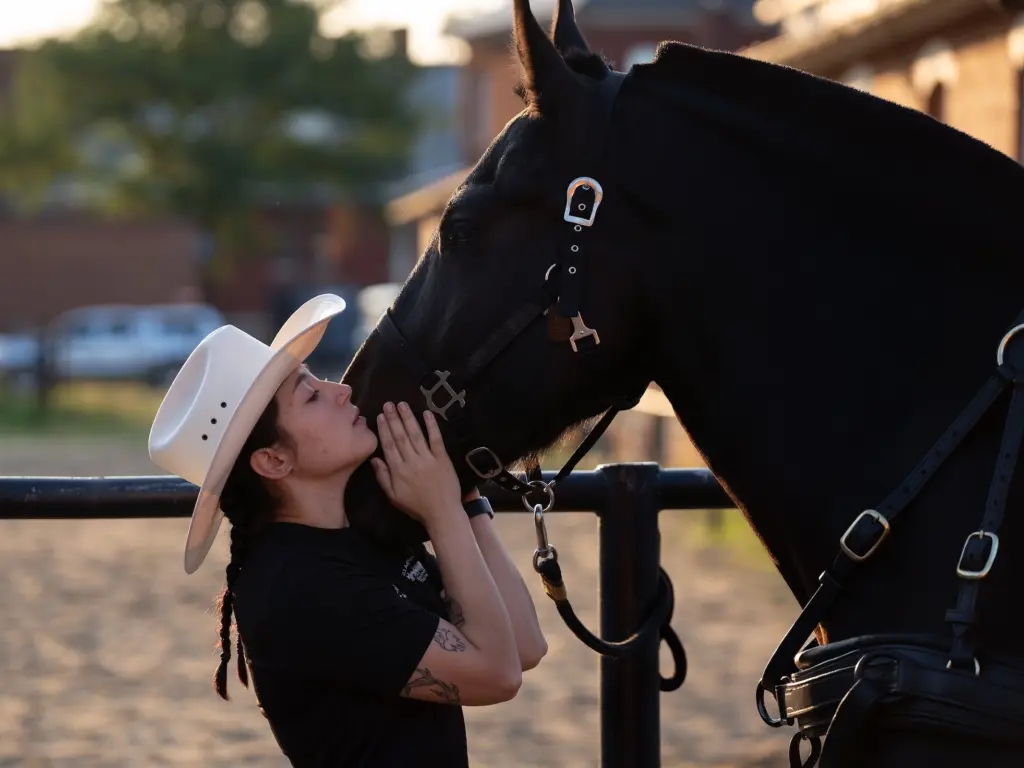
In a significant reversal, the United States Army has decided to preserve two of its historic ceremonial horse units.
Winds of Change
The Army will maintain Military Working Equid programs at Fort Riley, Kansas and Fort Hood, Texas. Each program will house 22 horses and 2 mules, with approximately 30-40 soldiers caring for and working with the animals.
“After careful consideration, the Army has determined that retaining these military working equine programs is in the best interests of the force,” stated Col. James Fuhriman, assistant deputy for Army health affairs. “These programs provide unique capabilities and benefits that are difficult to replicate.”
Horsepower in Danger
Last summer, the Army announced plans to eliminate five ceremonial horse units to save approximately $2 million annually. The decision would have affected Fort Riley, Fort Hood, Fort Irwin, CA, Fort Huachuca, AZ, and Fort Sill, OK, putting 141 horses up for adoption. However, the Army recognized the value these units bring beyond operational costs. Although the programs at Fort Irwin, Fort Huachuca and Fort Sill will close by July 2026, with their horses transferred or adopted to suitable homes.
The Lucky Few
Fort Riley’s 1st Infantry Division Commanding General’s Mounted Color Guard represents Civil War-era cavalry traditions, maintaining 18 horses and 4 mules with soldiers performing authentic period drills.
Fort Hood’s 1st Cavalry Division Horse Cavalry Detachment represents the Army of the late 1880s. With 29 horses and 4 mules, troopers carry 1873 Springfield carbines, Colt revolvers and cavalry sabers. The unit performs drills based on the Army’s 1883 cavalry tactics manual and has participated in presidential inaugurations and the Tournament of Roses Parade more than 20 times.
Both units will serve as bridges between the military and civilians through public demonstrations, educational outreach, and community events.
Why It’s Important
The reversal highlights an important recognition, these horse units serve as powerful recruitment and public engagement tools for civilian connection to the military. The ceremonial units regularly participate in parades, rodeos, school visits, and community events, offering tangible connections to military history.
New Horse Job Alert
Alongside the preservation decision, the Army established a new military occupational specialty: Army Equestrian (08H). This specialized career path, open to infantry soldiers in grades E5-E9, is dedicated to professional care of military working equines, demonstrating the Army’s commitment to maintaining high standards of horsemanship.
The decision comes after the Army faced scrutiny over equine welfare. A 2022 assessment revealed issues across programs, including the Arlington National Cemetery caisson unit. Improvements have since been made, including consulting with the Royal Canadian Mounted Police and Olympic equestrian David O’Connor developing a comprehensive horsemanship training course.
Standing Traditions
The Army’s most prestigious programs remain unchanged. The Old Guard’s caisson units at Arlington National Cemetery and Joint Base San Antonio will continue performing military funeral honors, a tradition dating back to 1948.
For horse enthusiasts and military history lovers, the preservation of Fort Riley and Fort Hood’s cavalry units ensures that mounted soldiers in period uniforms will continue to inspire future generations about America’s military heritage.