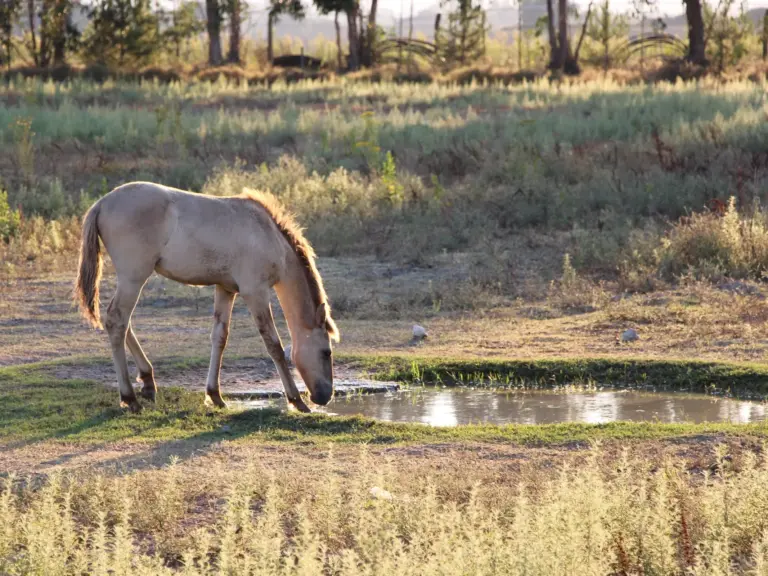
The Sorraia has long been promoted as the last remnant of wild horses that lived across most of the Iberian Peninsula, including parts of Spain and Portugal. Although they are often described as what remains of an indigenous wild horse, that has not been shown genetically: what is certain is that they are a tiny, nearly extinct population of primitive type. Only recently, after the Portuguese National Stud took over registration of these animals, have they been promoted as a ‘breed’.
Origins
These horses are of an old, primitive type and rather important in terms of their genetics. They were once thought to be the fathers of the mighty Iberian breeds who went on to spread their genetics worldwide, but no genetic study has shown them to be the ancestor of the Lusitano or the Andalusian, and their maternal DNA shows very little variation, the mark of a tiny group of founders. Named for the Sor and Raia rivers which irrigate the plains on which they have roamed for the last thousand years. Cave art from before the last Ice Age depicts animals that look very similar to the Sorraia on the Iberian Peninsula.
The Sorraia has been described as one of the few types of original wild horses and as a relative of the now extinct Tarpan, as they tend to resemble each other in physical appearance, but resemblance is not descent.
It is thought that Sorraia animals were among the first to be taken to the Americas by Spanish as they were adaptable, hardy and useful as pack animals. Which would explain many of the breeds from the Americas with grulla coloring and primitive markings. This breed is also believed to have migrated across the land-bridge at Gibraltar to North Africa in ancient times and are thought to be a basis for the hardy North African Barb. For these reasons they have been looked at as a grandfather of modern domestic horse, a claim the genetic evidence does not support.
However important their genetics are, this is a very rare breed. There are small numbers of dedicated breeders in both Portugal and Germany, but their numbers are dangerously low.
Features
Average height 14 hands
Physique
Head often has convex profile
Eyes are high set
Ears are long
Neck is long and slender
Back is average in length and straight
Chest is deep and narrow
Legs are long and well built
Hooves are dark and hard
Traditional Colors
grulla with primitive markings
Temperament
Calm and steady
Intelligent and quick reactors
Use
Riding horse
Pack horse
Special Thanks
Many special thanks to Reinhard Oelke who provided us with updated facts and information about the Sorraia. Many of the facts here are his – you can find out more about him and Sorraia horses on his website Sorraia.org.
Helpful Links
More Images

