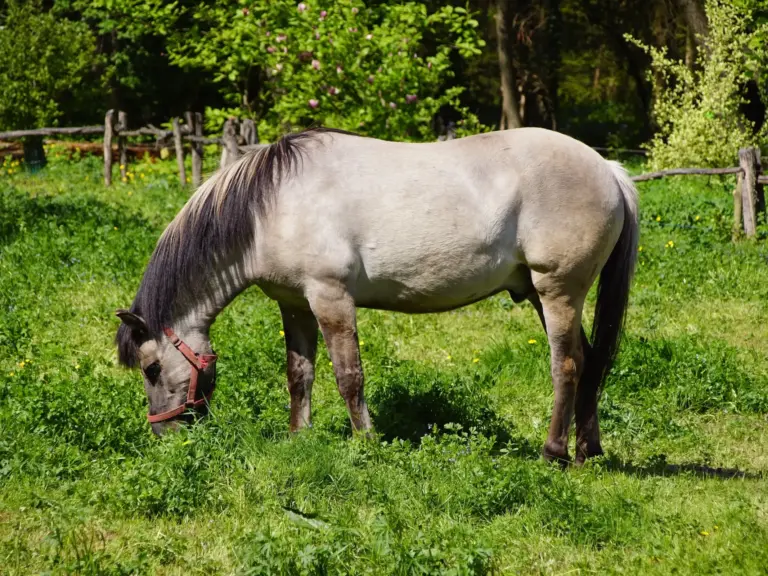
Also called Konik Polski, the Konik horse has long been described as a direct descendant of the ancient Tarpan, and their name translates to little horse. Genetic studies show a hardy domestic horse that looks like a tarpan, not a surviving wild one. This is a primitive breed, generally homogeneous in their handsome grullo coloring.
Origins
Tradition traces them to wild horses found in Lithuanian forests late in the 18th century: the remaining animals are said to have been rounded up in 1786 and put into the Zamość zoo where they remained until it was dissolved in 1806. When this happened the horses were given to local farmers who used them for agriculture and transportation. Genetic studies of the Konik contradict the idea of a wild relict: its maternal lines are a mixture shared with domestic breeds across the world, which is what you would expect from a farm pony. Their robust nature made them useful during the war season of early 20th century, but it also took a toll on their pure blooded numbers.
A reserve was founded in 1954 by the Polish Academy of Science to protect the breed and in 1962 a studbook was established to centrally control breeding. According to the DAD-IS they are listed as endangered maintained and as of 2023 there were between 3200 and 3500 registered.
Features
Average height 12.3 – 13.3 hands
Physique
Body is rectangular and low set
Chest is large and full
Traditional Colors
Generally grullo dun with primitive markings
Temperament
Highly intelligent
Robust and easy to train
Use
Children’s mount
Light agriculture
Farm animal
Helpful Link
Polish Horse Breeders Association
Polish Genetic Biodiversity Programs
More Images


